
Hip arthritis: how Franck rebuilt his karate through mindset
Karate champion Franck shares how he overcame hip arthritis and rebuilt his sporting practice through mental strength and resilience.
By Benjamin Sant · Updated on 20 November 2026
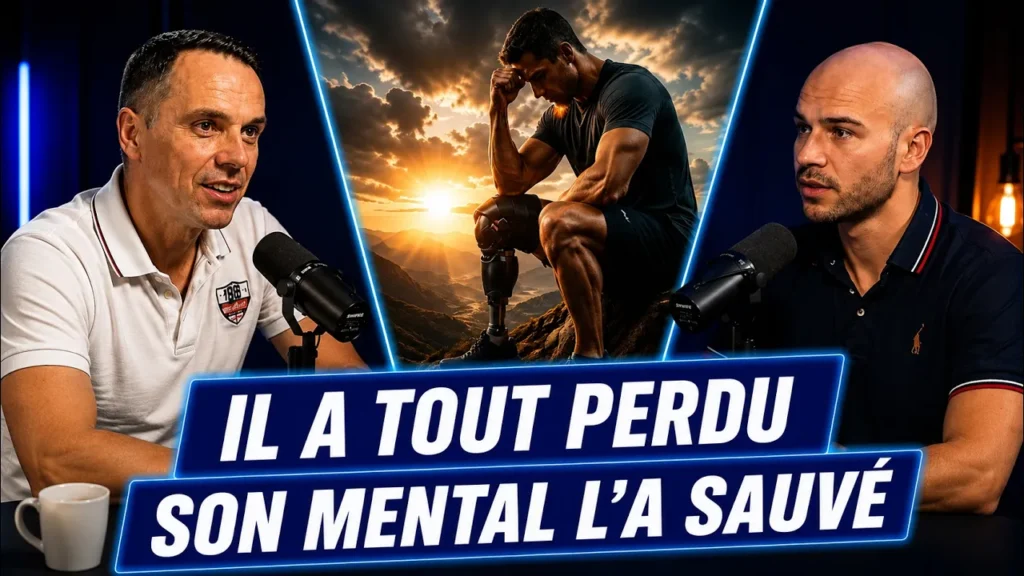
One morning, a medical verdict can turn an entire life built around movement upside down. This is what happened to Franck, a karate champion and mental preparation coach, when at the age of forty one a doctor diagnosed him with coxarthrosis, arthritis of the left hip. Behind this technical term lies a brutal reality: damaged cartilage, with no treatment able to regenerate it, and the threat of a complete halt to four decades of martial arts practice. His story, told in this new episode of the Corps et Conscience podcast, is one of physical reconstruction, but above all, mental reconstruction.
Watch the full episode on YouTube
Karate becomes an obvious path from childhood
Franck starts with judo at six or seven, like many children of his generation. But it is while watching his friends move towards karate that he walks, at the age of eight, through the door of another dojo. This turning point, which he describes as a simple quirk of circumstance, never leaves him: more than four decades later, he still practises.
His path illustrates a paradox specific to this sport: high level karate demands an almost professional commitment, with training volumes reaching fifteen to twenty hours a week combining technique and physical preparation, even though the financial rewards remain very limited compared with other disciplines. Franck experienced this gradual shift from pure competition to teaching, setting up an organisation with friends and his father around twenty five years ago. This transition does not mean giving up competition altogether, since he continues to support athletes, but it changes the nature of his practice, now more focused on research and deepening his martial understanding.
The arthritis diagnosis triggers a psychological collapse
It all begins with pain in the groin, on the left side, which Franck initially puts down to a simple tendinitis or strain. The first examinations reveal nothing alarming. But the pain persists, and further tests lead to a diagnosis of coxarthrosis. For a man whose sport has been part of him since the age of eight, the announcement feels like a sentence.
Franck says he immediately thought of his grandfather, who had a conventional hip replacement around the age of sixty, with all the restrictions that came with it: having to be careful getting out of the car, being unable to bend forward or cross his legs, and even a fall that caused the prosthesis to loosen. Imagining these constraints applied to his own karate and kickboxing practice is a real shock to him. He says plainly that he does not take the news well, even though he is aware that other conditions are far more serious. This moment marks the start of a search: that of a surgeon able to offer an alternative to conventional techniques.
Meeting a forward thinking surgeon changes the course of events
Franck then throws himself into extensive research and discovers that surgical approaches vary considerably depending on the practitioner, the technology and the materials used. He eventually finds a surgeon he describes as forward thinking, able to offer him an optimistic outlook despite the need for a hip replacement.
The surgical journey involves three operations. The first attempt consists of a bone graft, taken from the iliac crest, in the hope of avoiding a prosthesis altogether. This gamble does not work. Next comes the fitting of a custom made titanium prosthesis, an intervention Franck describes as magical. The result exceeds his expectations: he returns not only to karate, but also to wakeboarding and snowboarding, disciplines involving falls and direct impacts on the joint. He speaks of a complete resurrection, insisting that his return to physical activity was a full recovery, with no restrictions whatsoever in his martial arts practice or in his board sports.
Breathing and the slowness of tai chi complement his martial practice
After this ordeal, Franck brings tai chi and yoga into his daily sporting routine. Tai chi reveals a dimension he thought he had already mastered: breathing. Used to a dynamic form of karate, centred on action and effort, he discovers through tai chi the need to break down every movement, to position it, and to unfold it in coordination with the breath.
Yoga, for its part, complements this work through stretching and work on the psoas, bringing balance between the strain generated by intensive martial training and a kind of reset for the body. Franck describes this complementarity as a relationship of yin and yang: on one side, karate, which demands a great deal from the body and sometimes pushes it hard, and on the other, tai chi and yoga, which repair it and bring it back into balance. This approach echoes a broader logic in longevity, where combining strength training, cardiovascular work and mobility forms an essential tripod for ageing without losing independence.
Enjoyment is a key condition for long term success
Over the course of his research into mental preparation, which began around twelve years ago through training in neuro linguistic programming, sophrology and potential optimisation techniques, Franck has identified a factor that is often overlooked: enjoyment. He gives the example of Émilie Cachu, a former member of the French national karate team, who won a French championship after a six to seven month maternity leave, while being under trained compared with her competitors. In her interview, she highlighted the pleasure of coming back without pressure, simply to enjoy her competition.
Franck links this observation to his own experience: he recalls a competition where, feeling overwhelmed, he chose to go for a swim before stepping onto the tatami rather than sticking to his usual focus rituals. He won that competition comfortably. This notion of enjoyment does not mean letting go of rigour or discipline, he points out, but represents a genuine variable in the performance equation, alongside goal setting, visualisation and breathing, the three pillars he considers most important for keeping a strong mindset.
Setting goals turns inner resources into concrete energy
Franck places particular emphasis on the role of goal setting as a driver of resilience. He cites the case of Philippe Croizon, a quadruple amputee who swam across the English Channel after watching a report about a seventeen year old girl achieving the same feat. For Croizon, the initial goal was not the crossing itself but a broader desire: to change his life. This ambition was then broken down into concrete sub-goals, generating the motivation needed to overcome considerable obstacles.
Franck carried out a genuine field investigation, meeting around ten people who had been through major trauma, even travelling to Edinburgh to speak with Jamie Andrew, a professional mountaineer who lost all four limbs during a climb. The same mechanism appears in every case: a precise goal triggers, in a chain reaction, the setting up of a system, which in turn generates daily motivation. This approach mirrors methods used in the military, where breaking down an overall challenge into very short stages, such as holding out until the next meal rather than thinking about the whole week ahead, significantly increases success rates in extreme training programmes.
Watch the full episode on YouTube
Taking action
Franck’s story shows that a feared diagnosis does not necessarily mean the end of a passion, provided it is combined with sound medical expertise and structured mental work. A clear goal, sensory visualisation, controlled breathing and genuine enjoyment form a foundation that can be applied to any process of reconstruction, whether sporting or personal.
These principles belong to the realm of prevention and lifestyle, alongside medical follow-up and never in its place. For an approach suited to your situation, discover Elite Longevity support programmes. The details are set out during an initial conversation.
Sources
This article is built on the first-hand account recorded for the podcast, whose full episode is available on YouTube. The references below document the topic it covers.
Scientific references on the topic
- The Benefits of Adding Manual Therapy to Exercise Therapy for Improving Pain and Function in Patients With Knee or Hip Osteoarthritis: A Systematic Review With Meta-analysis. J Orthop Sports Phys Ther, 2022.
- Diagnosis and Treatment of Hip and Knee Osteoarthritis: A Review. JAMA, 2021.
- Osteoarthritis. Lancet, 2019.
- How does hip osteoarthritis differ from knee osteoarthritis?. Osteoarthritis Cartilage, 2022.
Frequently asked questions
What is the coxarthrosis Franck talks about in the episode?
Coxarthrosis is a form of hip arthritis corresponding to a breakdown of the joint cartilage. There is currently no medical treatment able to regenerate this cartilage once it is damaged, which is why Franck turned to a surgical solution involving a hip replacement after an unsuccessful bone graft attempt.
Can you take up intense sport again after a hip replacement?
Yes, according to Franck, who went back to karate, wakeboarding and snowboarding after having a custom made titanium prosthesis fitted. He stresses, however, how important it is to choose the right surgeon and the right technology, as materials and techniques have advanced considerably in recent decades.
What mental preparation techniques has Franck studied?
Franck trained in neuro linguistic programming up to practitioner level, in potential optimisation techniques drawn from the military world, and in sophrology. He combines these methods according to each person’s needs rather than relying on just one exclusively.
Why is enjoyment important in sporting practice, according to Franck?
Franck observes that neglecting enjoyment leads to failure in the long run, even if performance remains possible in the short term. He gives the example of an athlete who won a championship by focusing on enjoyment rather than intensive training, proof that this dimension must be an integral part of any serious preparation.
How do tai chi and yoga complement intensive martial arts practice?
Tai chi brings a deeper awareness of breathing and slowness of movement, while yoga works on stretching and mobility, particularly around the psoas. Together, they help rebalance the body after the strain caused by intensive martial training.
What is the goal setting method used by special forces mentioned in the episode?
It involves breaking down an overall challenge into very short stages, such as holding out until the next meal rather than thinking about the entire week ahead. This method, developed by a military psychologist for Navy SEAL training, increased candidates’ success rate by making the effort more psychologically manageable.
Latest from the blog
Read next
 Insulin resistance: Jérôme Perottet explains the mechanism
Jérôme Peroté, physiotherapist and nutritionist, explains why insulin resistance affects even people who eat little sugar, and how to detect…
Read the article
 Stem cells: Christian Drapeau’s secret to repair
Christian Drapeau, a neurophysiology researcher, explains how to stimulate your own stem cells to slow ageing naturally.
Read the article
 Nutrigenomics: Georges Mouton on eating for your genes
Dr Georges Mouton explains why eating according to your genotype changes everything for digestion, the heart and the brain.
Read the article