
Thyroid: Dr Pierre Nys on falsely normal results
An endocrinologist decodes TSH, T3, T4, Hashimoto's and stress to explain the real drivers of thyroid fatigue.
By Benjamin Sant · Updated on 20 November 2026
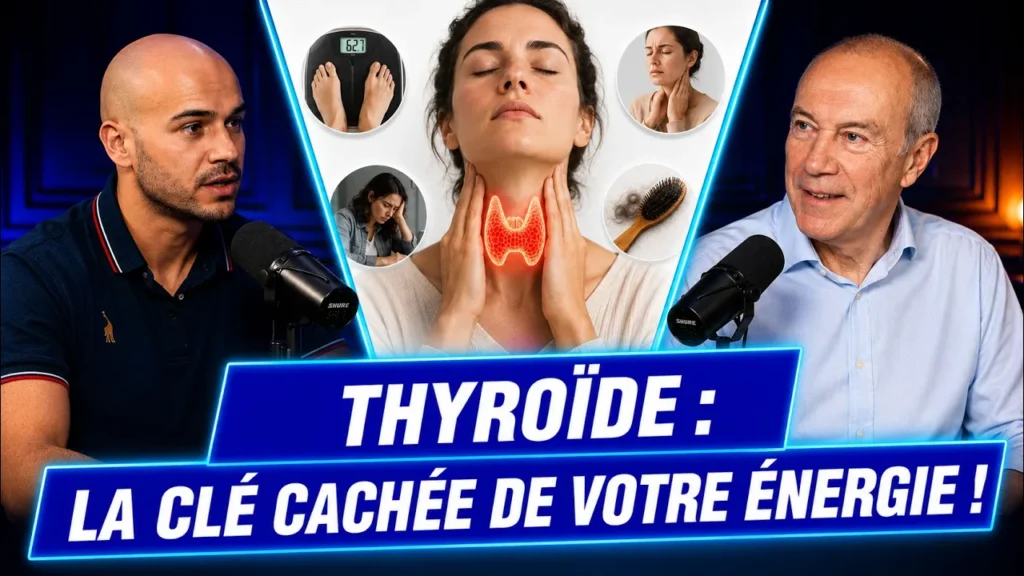
You have perfectly normal thyroid results, and yet you’re dragging around a permanent, unexplained fatigue, one that feels almost shameful because no one validates it biologically. This paradox is one that Dr Pierre Nys, an endocrinologist, nutritionist and diabetologist attached to the Paris hospitals, encounters constantly in his practice. His answer is clear: « it’s clear that in people who have a deficit in converting T4 to T3, despite correct test results, they will feel tired, because T3 has an effect on the mitochondria, which are these energy factories at cellular level ». A recognised thyroid specialist and author of several bestsellers, including « Incroyables hormones » and the brand new « Le nouveau régime thyroïde », here he dismantles the misconceptions about a gland too often reduced to a simple TSH figure.
Watch the full episode on YouTube
TSH alone doesn’t tell the whole hormonal story
Officially, health authorities recommend measuring only TSH as a first-line test. This hormone, secreted by the pituitary gland, varies inversely with thyroid function: if it rises, it means thyroid hormones are lacking, and if it falls, it means there’s too much of them. But Pierre Nys insists on a major limitation of this isolated measurement: the thyroid mainly produces T4, a prohormone, at a ratio of roughly 75 to 1 compared with T3. Yet it is T3 that acts on cellular receptors, particularly those found on the mitochondria.
This is precisely where things go wrong for many patients. You can have a TSH and T4 that are perfectly within normal ranges while still suffering from a deficit in peripheral conversion of T4 to T3, a link that standard tests don’t systematically explore. The result: patients deemed « well balanced on paper » who are nonetheless exhausted, a phenomenon the endocrinologist regularly observes in people followed up for weight issues or physical recovery problems.
Hashimoto’s is on the rise and remains largely underestimated
Hashimoto’s disease, first described in 1912 in a German-language journal, only entered public conversation around five years ago, driven by social media. This autoimmune condition is characterised by the production of anti-TPO and anti-thyroglobulin antibodies that hinder the conversion of hormones and their release from thyroglobulin, the gland’s storage protein. The figures given by Pierre Nys put the prevalence of detectable antithyroid antibodies at around 4% in the general population, a rate that climbs dramatically after menopause, to between 15 and 20%.
The causes remain partly mysterious, but one culprit is unambiguously identified: tobacco. It contains thiocyanates, genuine « almost natural antithyroid agents » in the specialist’s words. Added to this are the endocrine disruptors found in cleaning products, certain cosmetics and excess fluoride compounds. Pierre Nys highlights an essential rule on this subject: the severity of an endocrine disruptor doesn’t depend on the quantity absorbed, a microdose can produce a massive effect by stimulating the receptor, blocking it, or modulating hormone transport.
Faced with Hashimoto’s, which he nicknames, with a touch of humour, « the sad slug » given how insidiously fatigue and weight gain set in, the answer lies in overall lifestyle habits. A varied, fresh diet, regular physical activity with anti-inflammatory effects that also benefit T4 to T3 conversion, and cutting out ultra-processed foods: these levers don’t cure the disease, but they clearly limit its day-to-day impact.
Diet corrects deficiencies before the condition sets in
Before reaching the stage of synthetic hormone treatments, there’s a preliminary phase in which nutrition plays a decisive role. Pierre Nys cites three common deficiencies to correct: iodine, selenium and, to a lesser extent, zinc and tyrosine, which are provided by legumes. The SuViMax study even showed that populations living near the coast can present with iodine deficiencies, it all depends on actual consumption of seafood, eggs and certain dairy products.
Selenium is found in particular in Brazil nuts, a simple habit to adopt. But watch out for a subtlety the endocrinologist is keen to correct: the iodisation of salt, decided by health authorities to combat historical deficiencies such as that behind the « cretins of the Alps », is problematic because salt is otherwise advised against in excess. It’s better to favour natural food sources.
One piece of advice runs through his thinking again and again: favour a low glycaemic index diet. This choice doesn’t act directly on thyroid function, but it does lessen the consequences of a hormonal imbalance, whether that’s weight gain or fatigue. « You have to learn to do your shopping, learn to cook, learn to eat healthily, » he sums up, a discipline that applies to everyone, athletes and non-athletes alike.
Chronic stress disrupts the thyroid through a little-known domino effect
Stress doesn’t just wear you down mentally, it acts directly on thyroid biology, particularly in hyperthyroidism. Pierre Nys details a chain reaction: chronic stress disrupts liver function, promotes fatty liver disease, and thereby prevents the liver from properly clearing the hormone surplus it’s normally responsible for regulating. Combined with cortisol’s direct action on the thyroid, this disruption can trigger or worsen hyperthyroidism.
The example he shares is striking: a patient developed catastrophic hyperthyroidism after losing her small dog. The intensity of a triggering factor remains deeply individual, which makes prevention tricky for families already predisposed to thyroid conditions. In these cases, avoiding avoidable excess stress and maintaining a regular diet, without sudden shocks such as a meal suddenly very rich in iodine, becomes a concrete precaution.
On managing stress day to day, Pierre Nys is direct: meditation, often presented as a miracle solution, rarely works alone because it requires time and consistency that are hard to maintain. Instead, he recommends simple, accessible exercises: gratitude, positive affirmations, breathing, cardiac coherence. Modest but regular tools, more effective than a demanding practice abandoned after a few weeks.
The hormonal decline after forty deserves genuine monitoring
Past the age of forty, men and women experience a progressive hormonal decline that also affects the thyroid, indirectly. Pierre Nys points to a frequent association between thyroid conditions and autoimmune adrenal conditions, which is why he recommends checking adrenal function even when thyroid test results seem fine. In menopausal women, the rise in antithyroid antibodies is thought to be linked to declining oestrogen levels, a connection still poorly explained but statistically solid.
On hormone replacement therapy, his position is clear: « from the moment you’re on replacement hormone treatment and followed up by competent people, there’s no particular risk ». He points out that the controversies mainly stem from Anglo-Saxon studies using products different from those prescribed in France. In men, he recommends monitoring testosterone and DHEA sulphate, a hormone precursor that each body converts according to its own needs, while closely monitoring prostate risk before any testosterone supplementation.
The figures he cites illustrate a cultural gap: around 30% of American women benefit from menopause hormone therapy, compared with only 6 to 8% in France. A gap that, in his view, deserves to be questioned in light of the potential benefits for longevity and quality of life.
Watch the full episode on YouTube
Taking action
Between T4 to T3 conversion, Hashimoto’s antibodies, endocrine disruptors and chronic stress, the thyroid proves far more complex than a simple TSH line on a prescription. Listening to your body, questioning a « normal » result that doesn’t explain your fatigue, and consulting a specialist able to look for the right markers remain the best habits to adopt from the very first signs.
These pointers are part of prevention and lifestyle habits, to complement medical follow-up and never to replace it. For an approach tailored to your situation, discover Elite Longevity’s coaching programmes. The details are set out during an initial conversation.
Sources
The podcast conversation with Pierre Nys, whose full episode is available on YouTube, is the primary source for this article. The references below document the topics it covers.
Published work by Pierre Nys
- An observational study of the initial management of hypothyroidism in France: the ORCHIDÉE study. Eur J Endocrinol, 2012.
- [Acquired childhood and juvenile subclinical hypothyroidism with or without goitre]. Presse Med, 2005.
- Screening for thyroid cancer according to French recommendations with thyroid ultrasound in newly diagnosed Graves’ disease without palpable nodule is not useful. Ann Endocrinol (Paris), 2015.
Scientific references on the topic
- [Autoimmune thyroid disease]. Dtsch Med Wochenschr, 2021.
- Autoimmunity, New Potential Biomarkers and the Thyroid Gland-The Perspective of Hashimoto’s Thyroiditis and Its Treatment. Int J Mol Sci, 2024.
- Hypothyroidism Induced by a TSH Receptor Peptide-Implications for Thyroid Autoimmunity. Thyroid, 2024.
- TSH resistance revisited. Endocr J, 2015.
Frequently asked questions
Why can you feel tired when thyroid test results are normal?
Because standard tests often measure TSH and T4, but not always the efficiency of T4 to T3 conversion. Yet it’s T3 that acts on mitochondrial receptors, the cell’s energy factories. A conversion deficit can therefore cause real fatigue despite results that look balanced on paper.
What exactly is Hashimoto’s disease?
It’s an autoimmune disease in which the body produces anti-TPO and anti-thyroglobulin antibodies that attack the thyroid. First described in 1912, it has become better known recently thanks to social media. It causes fatigue, weight gain and a feeling of bloating, and remains the leading cause of hypothyroidism.
Does smoking really have an impact on the thyroid?
Yes, and significantly so. Tobacco contains thiocyanates, substances that Dr Pierre Nys describes as almost natural antithyroid agents. This is one of the most powerful, and most avoidable, endocrine disruptors, with a direct effect on thyroid hormone balance.
Which foods should you favour to support your thyroid?
Seafood and certain eggs or dairy products for iodine, Brazil nuts for selenium, and legumes for zinc and tyrosine. A fresh, varied diet with a low glycaemic index and no ultra-processed foods completes this nutritional foundation, essential for proper thyroid function.
Can stress really trigger hyperthyroidism?
Yes. Chronic stress disrupts liver function, promotes fatty liver disease, and limits the liver’s ability to clear hormone surpluses. Combined with cortisol’s direct action on the thyroid, this mechanism can trigger or worsen hyperthyroidism, sometimes following a one-off emotional shock.
Is menopause hormone therapy risky for the thyroid?
According to Dr Pierre Nys, hormone therapy correctly prescribed and followed up by competent professionals carries no particular risk. The controversies mainly stem from Anglo-Saxon studies using different products. In France, rigorous medical follow-up allows for safe, extended prescription as long as tolerance remains good.
Latest from the blog
Read next
 Insulin resistance: Jérôme Perottet explains the mechanism
Jérôme Peroté, physiotherapist and nutritionist, explains why insulin resistance affects even people who eat little sugar, and how to detect…
Read the article
 Stem cells: Christian Drapeau’s secret to repair
Christian Drapeau, a neurophysiology researcher, explains how to stimulate your own stem cells to slow ageing naturally.
Read the article
 Nutrigenomics: Georges Mouton on eating for your genes
Dr Georges Mouton explains why eating according to your genotype changes everything for digestion, the heart and the brain.
Read the article