
Guillaume Millet: exercise as a remedy for chronic fatigue
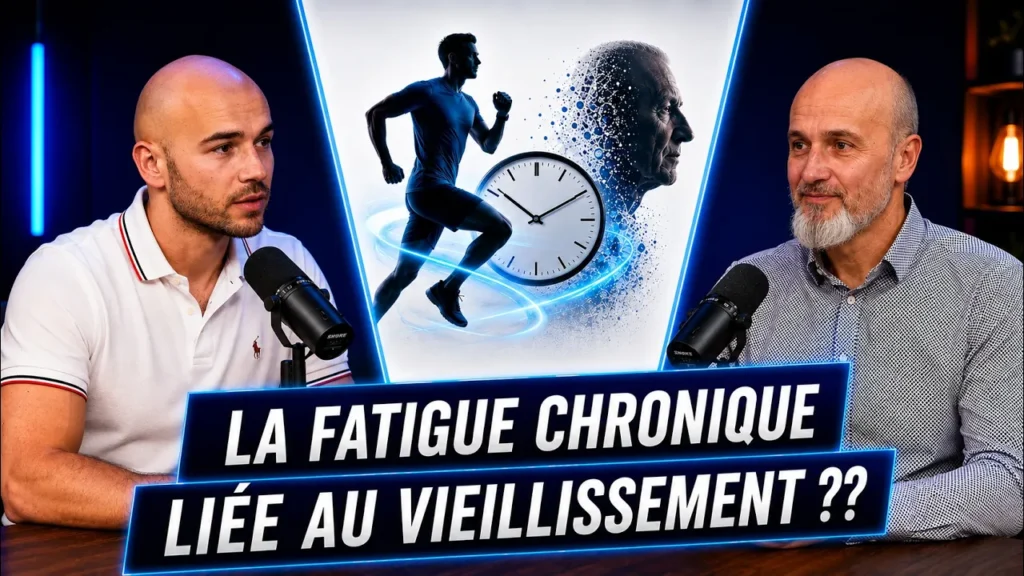
Physiologist Guillaume Millet explains why movement remains the best remedy for chronic fatigue and age related decline.
By Benjamin Sant · Updated on 20 November 2026
A cross country skier before he could even walk, a competitor from the age of ten, an ultra endurance runner for thirty years: Guillaume Millet has never really had to choose between his life as a researcher and his life as an athlete. It is precisely this dual perspective, that of the practitioner and that of the physiologist, that allowed him to understand a phenomenon affecting patients, older adults and exhausted athletes alike: the vicious circle of fatigue. A researcher at the University of Saint-Étienne and author of work cited more than 10,700 times, he has spent his career unpicking the mechanisms of neuromuscular fatigue, first out of personal passion, then out of scientific necessity.
Watch the full episode on YouTube
The vicious circle of fatigue affects patients and active retirees alike
Guillaume Millet says it plainly: there is a striking common thread between ageing and chronic fatigue, whatever its origin. In both cases, the first reaction is to move less. « You start to feel tired, so you end up spending a bit more time on the sofa, » he sums up. This withdrawal, which seems logical on the surface, sets off a formidable chain reaction: less activity leads to physical deconditioning, which makes everyday tasks harder, which in turn reinforces the feeling of fatigue.
This mechanism does not only affect people who are ill. Guillaume Millet cites the typical example of people who stayed active throughout their working lives but, once retired, slip into a sedentary pattern they never saw coming. « The day she retires, she enjoys herself, she takes a breather, but she takes that breather for so long that she ends up struggling to move at all. » The paradox is that the solution runs counter to instinct: to escape fatigue, you need to do precisely what the tired body refuses to do.
Perceived fatigue does not always match physiological reality
One of the most surprising findings from Guillaume Millet’s research concerns the link, ultimately quite weak, between fatigability measured in the laboratory and fatigue felt day to day. His studies, carried out in particular with people who had finished cancer treatment or who had multiple sclerosis, show that the people most fatigable under effort are also, on average, those who report feeling the most tired. But the correlation remains weak.
The figures sometimes even defy intuition. People in their sixties report, on average, feeling less tired than those aged twenty-five to thirty, even though their physical capacities are objectively lower. There is a similar surprise when it comes to differences between the sexes: women report more fatigue in questionnaires, even though they are physiologically more resistant to muscular fatigue thanks to muscle fibres better suited to endurance. For Guillaume Millet, this is explained by the multifactorial nature of fatigue: inflammation, sleep disorders, anaemia, depression or physical deconditioning can all produce the same symptom through entirely different biological pathways.
Movement remains the best lever, provided it is done intelligently
Despite this complexity, one conclusion runs through the whole discussion: physical activity acts on almost all the causes of chronic fatigue at once. It reduces inflammation, improves sleep, limits deconditioning and can even ease certain depressive symptoms when they are linked to inactivity. « The best way to fight decline linked to ageing, but also chronic fatigue, is to move, and to move a lot, » insists Guillaume Millet.
But he warns against rushing in. In his view, there are principles to respect and types of training to favour depending on age. Taking up activity again does not mean aiming straight for the performance levels of the past. This is the whole point of the Evalife project, developed in his laboratory: a self-contained station for assessing physical capacities, paired with an algorithm that proposes an individualised training programme to help frail or older people retrain at home.
Giving effort meaning changes everything: the example of the Zéro à Cent project
Guillaume Millet is currently leading a project that concretely illustrates this philosophy: Zéro à Cent. The goal is to support forty completely sedentary people, some of whom had not done any sport for twenty-five years, towards the CCC, a hundred kilometre race around Mont Blanc as part of the UTMB, over eighteen months. Participants started with ten minutes of walking, before gradually incorporating running, Nordic walking with poles and cycling, in a logic of varying the type of load on the body to limit injuries.
Each participant has a coach, weekly monitoring, regular laboratory measurements and immediate intervention at the slightest warning sign, somewhat in the manner of elite athletes. Guillaume Millet is honest about the uncertainty of the wager: « No one has done this before, so we cannot know whether it is possible. » But he highlights an essential point observed during the participants’ first group gathering: the strength of the collective. « I had perhaps underestimated the importance of the group, » he admits, echoing a conviction shared by coaches and mental performance trainers who support people returning to sport: without a goal that carries real meaning, motivation collapses quickly.
Diversity of movement protects the body at any age
For Guillaume Millet, physical literacy, that is to say the ability to master a wide repertoire of movements, is a major asset against injuries and for sporting longevity. He gives the example of someone who has only ever played football: the day they stop, they find themselves at a loss, sometimes even uncomfortable on a bicycle for never having learned as a child. Conversely, someone who tried several disciplines in childhood, from skiing to cycling to swimming, retains motor skills that are never forgotten.
This logic of variation remains valid in adulthood and even after seventy. Guillaume Millet recommends alternating running, Nordic walking with poles, cycling and strength training rather than always repeating the same activity. He does, however, qualify a sometimes overly alarmist discourse about sport after eighty: running becomes trickier, but Nordic walking, electric cycling and strength training with resistance bands remain accessible and beneficial, including for cognitive function, provided the intensity is maintained once or twice a week.
Aqua fitness alone is not enough to preserve muscle mass
Guillaume Millet points to a widespread misconception among older adults: the belief that very gentle activities such as aqua fitness are enough to keep the body in good condition. He acknowledges their social and cardiovascular benefits, but points to a significant limitation, the lack of sufficient resistance to counter sarcopenia, the progressive age related loss of muscle mass. Without load or a minimum of mechanical impact, muscle continues to erode, even in people who practise regularly.
The solution is not to abandon these activities but to supplement them with strength training, using resistance bands, light weights or simply body weight, two to three sessions a week. Guillaume Millet also stresses the value of exercising outdoors whenever possible: running or walking in nature combines the benefits of physical activity with those of contact with the natural world, an argument he defends with thoroughly personal conviction, being someone who still skis early in the morning in the Jura at fifty-seven.
Watch the full episode on YouTube
Taking action
Guillaume Millet makes the point with the dual authority of researcher and practitioner: movement remains the most powerful tool against chronic fatigue and age related decline, provided progression is respected and activities are varied. It is up to each of us to find, as he did in cross country skiing or as the Zéro à Cent participants did in their hundred kilometre goal, the form of movement that brings enough enjoyment to last over time.
These guidelines fall under prevention and lifestyle habits, complementing medical follow-up and never replacing it. For an approach tailored to your situation, discover Elite Longevity’s coaching programmes. The details are explained during an initial conversation.
Sources
The podcast conversation with Guillaume Millet, whose full episode is available on YouTube, is the primary source for this article. The references below document the topics it covers.
Published work by Guillaume Millet
- Sex Differences in Endurance Running. Sports Med, 2022.
- Biomechanics and Physiology of Uphill and Downhill Running. Sports Med, 2017.
- Exercise and colorectal cancer: a systematic review and meta-analysis of exercise safety, feasibility and effectiveness. Int J Behav Nutr Phys Act, 2020.
- Performance Determinants in Trail-Running Races of Different Distances. Int J Sports Physiol Perform, 2022.
Scientific references on the topic
- Exercise-mediated reinnervation of skeletal muscle in elderly people: An update. Eur J Transl Myol, 2022.
- Effects of deep cervical flexor training on impaired physiological functions associated with chronic neck pain: a systematic review. BMC Musculoskelet Disord, 2018.
- The Acute and Chronic Effects of Implementing Velocity Loss Thresholds During Resistance Training: A Systematic Review, Meta-Analysis, and Critical Evaluation of the Literature. Sports Med, 2023.
- Respiratory muscle fatigue. Clin Chest Med, 1988.
Frequently asked questions
Why is it difficult to break out of chronic fatigue by staying inactive?
Because inactivity triggers a vicious circle: fatigue leads to less movement, which causes physical deconditioning, making everyday efforts harder and further reinforcing the feeling of fatigue. According to Guillaume Millet, only a gradual return to physical activity can break this cycle for good.
Does perceived fatigue always correspond to genuine muscular fatigability?
No, the link is often weak. Guillaume Millet’s studies show that factors such as inflammation, sleep disorders, anaemia or depression can produce high levels of perceived fatigue without muscular resistance to effort necessarily being affected to the same degree.
Is aqua fitness enough to preserve muscle mass in older adults?
No. This activity remains beneficial from a cardiovascular and social point of view, but it does not provide enough resistance to counter sarcopenia. Guillaume Millet recommends supplementing it with strength training using resistance bands or light weights, two to three times a week.
Can you take up sport again after several decades of inactivity?
Yes, at any age according to Guillaume Millet, including after seventy or seventy-five. He recommends a prior medical check-up, followed by a very gradual return, starting with walking before introducing running, cycling or suitably adapted strength training.
What is the benefit of varying physical activities rather than specialising?
Diversity of movement, known as physical literacy, develops a broad motor repertoire that protects against injury and makes it easier to stay active at any age. Guillaume Millet cites the example of children who practise several sports, who are often more accomplished in the long run than those who specialise early.
What does the Zéro à Cent project led by Guillaume Millet involve?
It is a programme supporting forty completely sedentary people towards a hundred kilometre race around Mont Blanc over eighteen months, with individualised coaching, regular medical monitoring and very closely supervised progression, to test whether such a goal is achievable starting from zero.
Latest from the blog
Read next
 Insulin resistance: Jérôme Perottet explains the mechanism
Jérôme Peroté, physiotherapist and nutritionist, explains why insulin resistance affects even people who eat little sugar, and how to detect…
Read the article
 Stem cells: Christian Drapeau’s secret to repair
Christian Drapeau, a neurophysiology researcher, explains how to stimulate your own stem cells to slow ageing naturally.
Read the article
 Nutrigenomics: Georges Mouton on eating for your genes
Dr Georges Mouton explains why eating according to your genotype changes everything for digestion, the heart and the brain.
Read the article