
Hormones after 40: William Kadmiry on women’s bodies
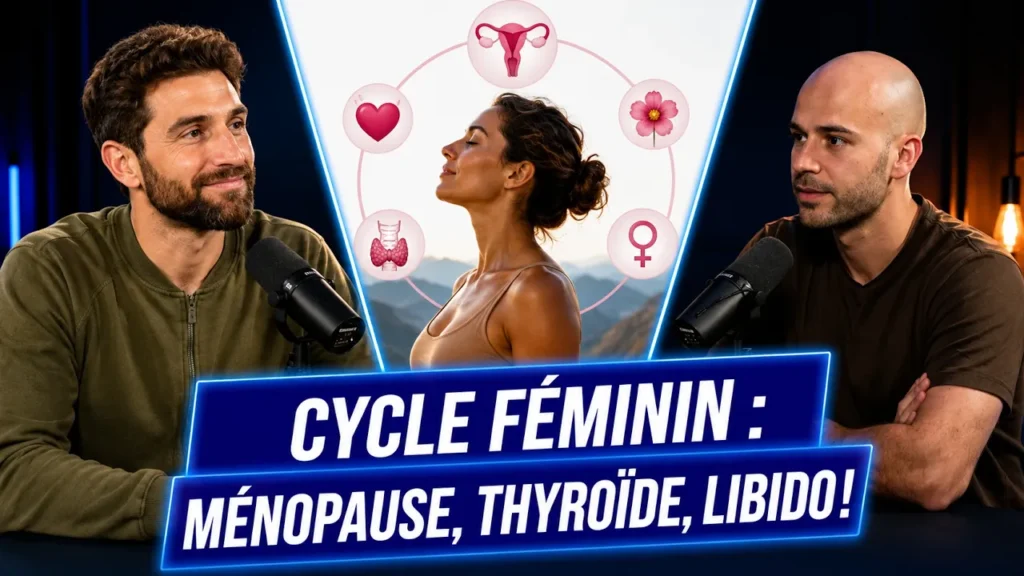
Naturopath William Cadmiri explains perimenopause: progesterone, oestrogens, thyroid and bio-identical hormones made simple.
By Benjamin Sant · Updated on 20 November 2026
A fatigue that settles in, cycles that go off track, a figure that changes despite constant effort. For many women, the forties mark the start of a string of symptoms that conventional medicine often treats one by one, without ever joining the dots. William Kadmiry, a naturopath specialising in micronutrition and functional hormone therapy, and co-founder of Naturanéo, offers an entirely different reading. After a career as a sports coach, during which he saw hundreds of women over 35 come to him to lose weight, he realised that physical exercise alone was never enough. This limitation pushed him towards naturopathy, then functional medicine, with one central conviction: a symptom is never isolated, it is the expression of a deeper imbalance.
Watch the full episode on YouTube
The drop in progesterone begins well before menopause
Contrary to popular belief, the first hormonal signals do not wait until the fifties. According to William Kadmiry, as early as 35, progesterone begins to decline in many women. This drop triggers fluctuations in oestrogen, sometimes too high, sometimes too low, a phenomenon known as oestrogen dominance, whether relative or absolute. This shift is never isolated: it sits within a broader life context often marked by the age at first pregnancy, postpartum recovery, breastfeeding, accumulated deficiencies, or autoimmune conditions such as Hashimoto’s thyroiditis, which is particularly common after childbirth.
This period also brings a considerable mental load, both professional and familial, which gradually wears down the body’s reserves. William Kadmiry puts it this way: the body pays for the excesses of the previous ten or fifteen years, a period during which vitality was still high enough to absorb poor habits. This capacity for compensation diminishes over time, which explains why behaviours tolerated at thirty suddenly become a source of symptoms once past forty.
The thyroid shapes the health of the ovaries
One of the most striking messages in the episode concerns the link between the thyroid and hormonal fertility. William Kadmiry notes that the thyroid is sometimes nicknamed the third ovary, an expression that is far from trivial. When T3 is lacking, the energy available for aromatase, the enzyme that converts testosterone into oestrogen, decreases. This slows the growth of the ovarian follicle, as well as oestrogen production.
In his practice, William Kadmiry almost systematically observes a TSH within normal range, but average or low T4 and T3 levels, with an often unfavourable T4/T3 ratio, and in around a quarter of cases, thyroid antibodies revealing an undiagnosed Hashimoto’s. This detail changes the whole support strategy: an autoimmune thyroid condition cannot be treated like simple functional thyroid fatigue. Hence the value of a complete biological work-up rather than a routine blood test, which often misses these nuances.
A shortage of protein weakens more women than you might think
Among William Kadmiry’s most recurring clinical observations is protein deficiency, particularly among flexitarian or vegetarian women. He describes the typical profile: a normal body mass index, but a figure described as skinny fat, meaning low muscle mass combined with relatively high fat mass, often with cellulite despite a weight considered acceptable. In these cases, calorie intake is generally underestimated, and above all lacking in nutritional density, with too little fat and protein on the plate.
Iron deficiency follows a similar logic, but at three distinct levels according to William Kadmiry: heavy periods linked to low progesterone, insufficient intake of foods rich in haem iron due to a voluntary or forced reduction in red meat consumption, and intestinal absorption problems linked to a lack of hydrochloric acid, intestinal permeability or dysbiosis. Non-haem iron from plant sources is absorbed at a rate of one to five per cent, compared with twenty to thirty per cent for haem iron from meat, a gap that explains why so many women struggle to correct their levels despite an apparently varied diet.
Progesterone is built on good ovulation
To understand how to influence progesterone, William Kadmiry returns to the basic physiology taught in biology class. The follicle containing the egg grows under the influence of oestrogen, then releases the egg before transforming into the corpus luteum, which secretes progesterone. Without ovulation, there is no corpus luteum, and therefore no significant progesterone, only the small amount produced by the adrenal glands, far too little to counterbalance oestrogen.
Several factors can then block the action of this progesterone even when it is being produced: elevated prolactin due to stress or hypothyroidism, oestrogen dominance saturating the receptors, micronutrient deficiencies needed for the synthesis of steroid hormones, or chronically high cortisol competing with progesterone for blood transporters, since transcortin is shared by both hormones. William Kadmiry sometimes uses chasteberry, a plant that does not directly increase progesterone but reduces prolactin by stimulating dopamine, thereby indirectly improving its biological availability.
Bio-identical hormone treatments are not the pill
One of the most important points raised in this episode concerns the common confusion between hormonal contraception and menopausal hormone therapy. William Kadmiry insists: many women refuse hormone replacement therapy, citing their poor past experience with the pill, when the two have nothing in common. The pill and hormonal coils use synthetic hormones, modified derivatives that the body does not metabolise in the same way. Bio-identical hormones, on the other hand, are strictly identical to those the body produces naturally, manufactured in a laboratory from molecules such as diosgenin extracted from wild yam or soy.
According to William Kadmiry, when these treatments are properly dosed, with oestrogen administered via transdermal cream and micronised progesterone, the available data show a reduction in all-cause mortality and an improvement in healthy life expectancy. He also mentions the work of Dr Mouly on cancer, according to which a well-managed treatment does not prevent a cancer that is already programmed to occur, but tends to make it less aggressive and easier to treat. He also points out that the American Women’s Health Initiative study from 2002, which triggered decades of distrust, examined Premarin, an oral treatment derived from mare’s urine, taken rather inconsistently by participants, and not the current French protocols, which are better dosed and far more closely monitored.
Strength training protects bones as much as hormones do
Beyond treatment, William Kadmiry highlights three levers available to all women for coping better with menopause without medication: maintaining good adrenal health to sustain DHEA and testosterone production, looking after the thyroid, whose deficiency symptoms resemble those of low oestrogen, and accepting a slight weight gain rather than striving for excessive thinness, since fat tissue produces oestrone, a protective oestrogen at this stage of life.
Strength training, however, remains the non-negotiable pillar. William Kadmiry directly links muscle mass to bone density, since muscle is attached to bone by the tendon. A woman with good muscle tone has stronger bones, which drastically reduces the risk of fracture linked to osteoporosis, a condition that can trigger a cascade of serious complications after a simple fall. The recommendation is clear: from the age of fifty, resistance training, whether at the gym or at home, becomes as essential as any hormone treatment.
Watch the full episode on YouTube
Taking action
Perimenopause is not a fate to be endured in silence, nor simply a matter of hormones that a pill alone could fix. As William Kadmiry shows, it plays out at the crossroads of the thyroid, stress, nutrition and muscle, and calls for a patient, well-informed and personalised approach. A complete biological work-up and an honest conversation with a gynaecologist remain the best starting point for distinguishing what is normal ageing from what deserves real support.
These pointers fall under prevention and lifestyle, alongside medical follow-up and never in its place. For an approach tailored to your situation, discover the Elite Longevity support programmes. Details are provided during an initial conversation.
Sources
The podcast conversation with William Kadmiry, whose full episode is available on YouTube, is the primary source for this article. The references below document the topics it covers.
Scientific references on the topic
- The 2023 nonhormone therapy position statement of The North American Menopause Society. Menopause, 2023.
- Use of menopausal hormone therapy beyond age 65 years and its effects on women’s health outcomes by types, routes, and doses. Menopause, 2024.
- A Contemporary View of Menopausal Hormone Therapy. Obstet Gynecol, 2024.
- Hormone Therapy in Menopause: Concepts, Controversies, and Approach to Treatment. Endocr Rev, 2021.
Frequently asked questions
From what age do women’s hormones start to decline?
According to William Kadmiry, the drop in progesterone can begin as early as thirty-five in many women, well before the first visible signs of perimenopause. It comes with fluctuations in oestrogen and growing fatigue, often made worse by stress, past pregnancies or micronutrient deficiencies built up over several years.
What is the difference between the contraceptive pill and menopausal hormone therapy?
The pill uses modified synthetic hormones, which cause many side effects. Bio-identical menopausal hormone therapy exactly reproduces the body’s natural hormones, manufactured in a laboratory from plant-based molecules. Their metabolisation and effects on the body are therefore nothing alike.
Why do so many women lack iron after 40?
William Kadmiry identifies three main causes: heavy periods linked to low progesterone, insufficient consumption of red meat, which is rich in better-absorbed haem iron, and intestinal absorption problems linked to intestinal permeability or dysbiosis, often combined in the same person.
Should weight gain be avoided during menopause?
No, according to William Kadmiry a slight weight gain is not a problem as long as it is not accompanied by rising lipid markers or an accumulation of visceral fat. Fat tissue produces oestrone, a protective oestrogen, which makes excessive thinness riskier at this stage of life.
Does strength training really have an impact on bones?
Yes, muscle is connected to bone via the tendon, and well-developed muscle mass directly improves bone density. William Kadmiry points out that this reduces the risk of fractures linked to osteoporosis, a condition that can lead to serious complications after a simple fall in an older person.
How can you tell if fatigue is hiding a thyroid imbalance?
A standard test looking only at TSH is often not enough. William Kadmiry recommends also assessing T3, T4 and their ratio, as well as checking for thyroid antibodies, in order to detect a sometimes silent Hashimoto’s hiding behind symptoms wrongly attributed solely to sex hormones.
Latest from the blog
Read next
 Insulin resistance: Jérôme Perottet explains the mechanism
Jérôme Peroté, physiotherapist and nutritionist, explains why insulin resistance affects even people who eat little sugar, and how to detect…
Read the article
 Stem cells: Christian Drapeau’s secret to repair
Christian Drapeau, a neurophysiology researcher, explains how to stimulate your own stem cells to slow ageing naturally.
Read the article
 Nutrigenomics: Georges Mouton on eating for your genes
Dr Georges Mouton explains why eating according to your genotype changes everything for digestion, the heart and the brain.
Read the article