
Microbiota and obesity: the work of Patrice Cani
Patrice Cani, a gut microbiota researcher, explains the links between gut bacteria, GLP-1, Akkermansia and obesity, with practical advice.
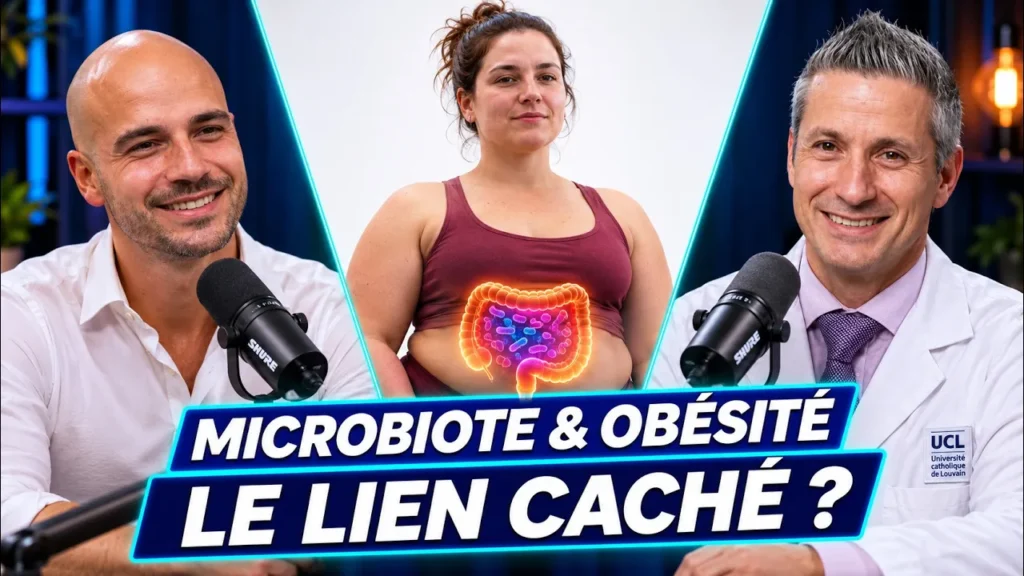
By Benjamin Sant · Updated on 20 November 2026
A student who dreams of cardiovascular surgery ends up, through a family turn of events, at a dietetics school in Brussels. Thirty years later, he ranks among the most cited researchers in the world on gut microbiota. Patrice Cani, professor at UCLouvain and visiting researcher at Imperial College London, tells this story with disarming honesty: from his very first year of dietetics, he already knew he wanted to go further than simple nutritional advice. A chance meeting in a corridor, in a student residence, with a fellow student enrolled in a research master’s in biomedical sciences, was enough to send him into the laboratory. He never left.
Watch the full episode on YouTube
His credo can be summed up in a sentence he repeats to his students: never be afraid of unanswered questions, because they are the ones that change the world. That is exactly what happened with his most significant work, which revealed the health effects of a bacterium now studied the world over: Akkermansia muciniphila.
The microbiota brings together billions of organisms whose roles are still poorly understood
Patrice Cani first insists on a point of vocabulary that is far from trivial: we should really speak of microbiotas, plural, given how much bacterial colonies differ depending on the area of the body, from the skin to the mouth, including the vagina or the lungs. His own field of study remains the gut, home to tens of thousands of billions of bacteria, as well as viruses, fungi and archaea, very ancient micro-organisms. Bacterial density follows a precise gradient: almost nil in the mouth, even lower in the stomach, it gradually explodes all the way to the colon, where each gram of matter contains billions of bacteria.
What strikes the researcher, after thirty years of career, is the sheer scale of what remains to be discovered. He says it plainly: no researcher in the world today knows the exact composition of a perfectly healthy microbiota. Certain compositions are associated with good health, others with the development of disease, but the precise map has yet to be drawn.
Dietary fibre triggers the production of a hormone now copied by the pharmaceutical industry
The story begins in the late 1990s, in the laboratory of Professor Marcel Roberfroid in Louvain-la-Neuve, where Patrice Cani is completing his PhD alongside Nathalie Delzenne. The team observes that rats fed fermentable fibres, the well-known prebiotics such as inulin or fructo-oligosaccharides, accumulate less abdominal fat and spontaneously eat less. There is a problem: these fibres are so water-soluble that they alter neither texture nor digestion speed. The effect therefore had to come from somewhere else.
By examining the animals’ caecum, a small pouch just before the colon, the researchers observe spectacular bacterial proliferation. They make the connection with a hormone recently isolated at the time, GLP-1, known for reducing appetite, increasing insulin secretion and improving glucose tolerance. The measurements confirm the hypothesis: fibres increase the production of this hormone, and even the number of intestinal cells capable of making it. Pharmacological experiments, carried out by blocking the GLP-1 receptor, went on to demonstrate the mechanism conclusively.
The biological mechanism is now well established by other teams: bacteria ferment fibres and produce short-chain fatty acids, acetate, propionate and butyrate, which literally knock on the door of the intestinal cells that produce GLP-1. Patrice Cani compares this to a bacterial key that opens a human lock. It is this very mechanism that pharmaceutical laboratories have learnt to mimic with massive doses, giving rise to drugs such as Ozempic, Wegovy or Mounjaro.
GLP-1 agonists require nutritional support that many patients lack
Patrice Cani recalls an essential physiological fact: the GLP-1 naturally secreted by the gut has a half-life of a minute and a half. This brevity is no accident, it guarantees that the body remains able to regulate itself between meals. The drugs, by contrast, artificially maintain high and constant levels, which completely changes the physiological picture.
The researcher also refuses the term « treatment for obesity », preferring to speak of body weight reduction. His reservations concern less the molecule itself, whose effectiveness against type 2 diabetes is well established, than its unsupervised use. Millions of people use these treatments without sufficient nutritional support, exposing themselves to muscle wasting and bone density loss, without knowing what will happen once treatment stops. Patrice Cani uses a telling image: this medicine should be a crutch to learn to walk with, not a permanent substitute for walking itself. The teams achieving the best results are those that build in multidisciplinary follow-up, capable of teaching suitable eating habits alongside the treatment.
Akkermansia muciniphila protects the gut barrier the way a moat protects a castle
The discovery of its health effects is the purest kind of scientific chance. In 2007, at a conference in Switzerland, Patrice Cani meets Professor Jacques Schrenzel, a specialist in clinical microbiology, who offers to carry out an in-depth analysis of the microbiota composition of his prebiotic-treated animals. The results reveal that more than a hundred bacterial taxa are affected, far beyond the bifidobacteria initially identified by Marcel Roberfroid. Professor Willem de Vos, working in parallel, isolates precisely a bacterium living close to the intestinal mucus: Akkermansia muciniphila.
To explain its role, Patrice Cani uses the metaphor of a fortress. The intestinal cells form the ramparts, the tight junctions are the mortar, the mucus represents the moat, and the immune system plays the role of soldiers keeping bacteria at a safe distance without exterminating them. Akkermansia lives precisely in this moat, regulating its thickness according to need. When this bacterium becomes scarce, mucus regulation goes awry and communication with the immune system becomes chaotic.
The first experiments administering the live bacterium to animals on a high-fat diet showed reduced weight gain, better insulin resistance and, above all, a clear improvement in gut barrier function. A result that echoed an earlier discovery by Patrice Cani with Professor Rémi Burcelin: metabolic endotoxaemia, the passage of bacterial toxins into the bloodstream when the gut barrier is compromised.
The pasteurised bacterium works better than the live bacterium thanks to a specific protein
An unexpected twist marked this research. Killing the bacterium through high-temperature autoclaving, to test whether it needed to be alive to have an effect, caused the team to discover that it lost all activity. But by pasteurising it at a much lower temperature, around 70°C for an hour and a half, a protein found on the bacterium’s hair-like structures, named Amuc1100, retained its active shape. A surprising result reported by PhD student Hubert Plovier: the bacterium killed by pasteurisation turned out to be more effective than the live bacterium.
This discovery had a direct regulatory consequence. The European Food Safety Authority, EFSA, authorised the marketing of the pasteurised form as a precaution, since some studies have linked the live bacterium to neurodegenerative diseases such as Parkinson’s, without proof of causality according to Patrice Cani. A paradoxical but fortunate outcome: all the beneficial effects demonstrated so far, including in cancer immunotherapy according to work carried out by other teams, have involved the pasteurised form.
Choosing a probiotic means knowing its full name, not just its genus
Patrice Cani hammers home a simple but often overlooked message: not all probiotics are equal, and a genus name such as Lactobacillus or Bifidobacterium tells you nothing about the actual effect. You need the genus, the species and the precise strain, rather like telling a chihuahua apart from a German shepherd despite a shared Latin name. His favourite example remains Escherichia coli Nissle 1917: the same bacterium, considered pathogenic under its generic name, becomes a recognised probiotic once its strain is specified.
To navigate this, he recommends being wary of promises that sound too good to be true, such as guaranteed rapid weight loss, and systematically checking three things: the full name of the strain, a credible minimum quantity, generally above one billion colony-forming units, and the existence of published clinical studies on that precise strain. The same principle of vigilance applies to prebiotics: a dose of three hundred milligrams of fibre per capsule will have no effect, since the scientific literature places the useful threshold between two and five grams a day.
As for his own daily diet, Patrice Cani grows his own kefir and turns it into a smoothie enriched with flaxseed, chia seeds, camu camu powder and fresh turmeric. A concrete way of feeding his microbiota without waiting for a miracle, relying on a variety of fibres and polyphenols, the compounds responsible for the bright colours of fruit and vegetables.
Watch the full episode on YouTube
Taking action
Between fermentable fibres, natural GLP-1 and bacteria such as Akkermansia muciniphila, the microbiota stands out as a central and largely underused player in metabolic health. Before turning to a medicine or a supplement, the dietary route remains, according to Patrice Cani, the first to explore, provided probiotics are chosen with the same rigour as a medical treatment.
These pointers are a matter of prevention and lifestyle, alongside medical follow-up and never in its place. For an approach suited to your situation, discover the Elite Longevity support programmes. Details are provided during an initial conversation.
Sources
The podcast conversation with Patrice Cani, whose full episode is available on YouTube, is the primary source for this article. The references below document the topics it covers.
Published work by Patrice Cani
- Gut microbiome and health: mechanistic insights. Gut, 2022.
- Metabolic endotoxemia initiates obesity and insulin resistance. Diabetes, 2007.
- Mucus barrier, mucins and gut microbiota: the expected slimy partners?. Gut, 2020.
- Supplementation with Akkermansia muciniphila in overweight and obese human volunteers: a proof-of-concept exploratory study. Nat Med, 2019.
Scientific references on the topic
- Diet-Induced Gut Dysbiosis and Leaky Gut Syndrome. J Microbiol Biotechnol, 2024.
- Effect of Diet and Dietary Components on the Composition of the Gut Microbiota. Nutrients, 2021.
- Exercise Training Modulates Gut Microbiota Profile and Improves Endotoxemia. Med Sci Sports Exerc, 2020.
Frequently asked questions
What is GLP-1 and why is it linked to the microbiota?
GLP-1 is an intestinal hormone that reduces appetite, increases insulin secretion and improves glucose tolerance. Fibres fermented by gut bacteria produce short-chain fatty acids that directly stimulate the cells producing this hormone, a mechanism discovered by Patrice Cani during his PhD.
What is Akkermansia muciniphila?
It is a bacterium that lives in the gut’s mucus layer and regulates its thickness, rather like a castle’s moat. Its effects were discovered by chance during cross-analyses of microbiota, and it is associated with better gut barrier function and reduced insulin resistance.
Do drugs such as Ozempic act like natural GLP-1?
Not exactly. Natural GLP-1 has a half-life of a minute and a half, whereas these drugs maintain continuously high levels. Patrice Cani recommends strict medical supervision and nutritional education to avoid muscle wasting and weight rebound once treatment stops.
How should you choose a good probiotic?
You need to check the full name of the strain, not just the genus such as Lactobacillus, ensure a sufficient quantity, generally above one billion units, and favour products backed by published clinical studies on that precise strain rather than by marketing promises.
Why does pasteurisation make Akkermansia more effective under certain conditions?
A surface protein, Amuc1100, retains its active shape at low pasteurisation temperatures but denatures at very high temperatures. This protein alone is enough to trigger the beneficial effects on metabolism and immunity, which allowed regulatory approval of the pasteurised form in Europe.
Should you favour diet or supplements for the microbiota?
Patrice Cani recommends starting with diet, with varied fibres, fermented foods such as kefir and colourful polyphenols. Supplements can usefully complement this, particularly for nutrients that are hard to obtain through diet alone, such as vitamin D or omega-3s.
Latest from the blog
Read next
 Insulin resistance: Jérôme Perottet explains the mechanism
Jérôme Peroté, physiotherapist and nutritionist, explains why insulin resistance affects even people who eat little sugar, and how to detect…
Read the article
 Stem cells: Christian Drapeau’s secret to repair
Christian Drapeau, a neurophysiology researcher, explains how to stimulate your own stem cells to slow ageing naturally.
Read the article
 Nutrigenomics: Georges Mouton on eating for your genes
Dr Georges Mouton explains why eating according to your genotype changes everything for digestion, the heart and the brain.
Read the article