
Pain and ageing: Matthieu Loubière’s perspective
A physiotherapist challenges common beliefs about ageing, chronic pain and massage, with practical keys to ageing strong.
By Benjamin Sant · Updated on 20 November 2026
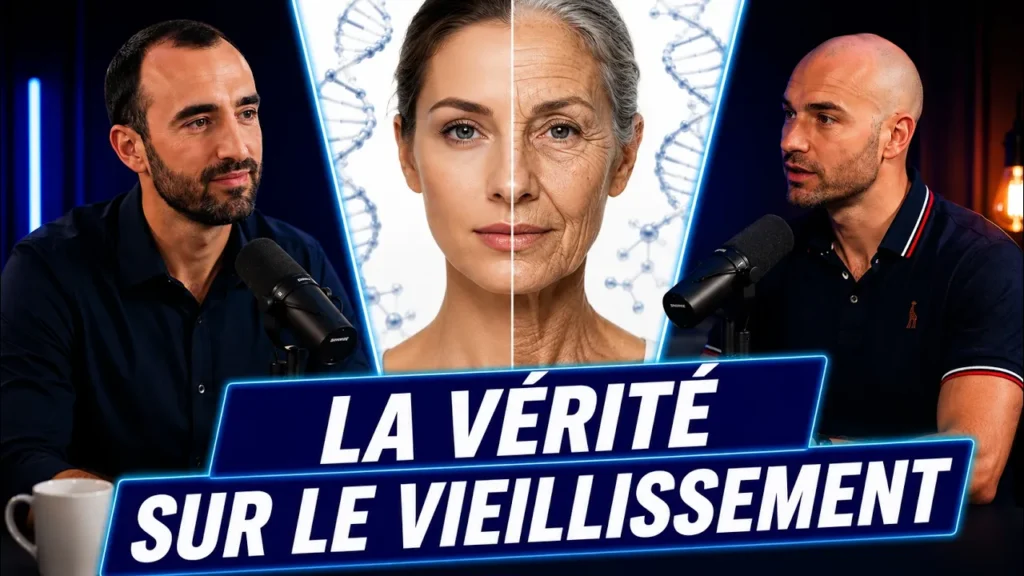
What if the phrase « it’s just age » were the biggest false excuse in everyday medicine? Matthieu Loubière, a physiotherapist for more than twenty years and a specialist in musculoskeletal disorders of the shoulder and spine, trains more than five hundred health professionals every year. His conclusion is as unsettling as it is liberating: most of the pain that appears after the age of fifty has nothing to do with the body wearing out, but with factors we can largely influence. Sleep, emotions, negative thoughts, nutrition, sedentary habits, fear of movement: these are the real accelerators of pain, far more than the years going by.
Watch the full episode on YouTube
The body is not a machine to be straightened out
For a long time, physiotherapy and osteopathy were built around a single paradigm: the « good hand », able to feel a displaced bone, a dislocated joint, the way a mechanic would spot a buckled wheel rim. Matthieu Loubière practised this approach before leaving it behind, not out of ideology, but out of intellectual honesty. « The body doesn’t shift out of place, we’re not a car with a bent wheel rim, » he sums up.
The trap, in his view, comes from perceptual bias. A therapist who wants to feel something under their fingers ends up feeling it, even when nothing abnormal exists. He compares this phenomenon to visual pareidolia, those shapes of unicorns or faces we think we see in the clouds: the brain attaches meaning to an image without there being any objective reality behind it. Palpation works on the same mechanism. Hence his insistence on never taking an isolated sensation at face value, but treating it as a hypothesis to be tested, never as a truth.
The same bias affects medical imaging. Multiplying X-rays, MRIs and ultrasounds mechanically increases the chances of finding « false positives »: abnormalities visible on the scan but with no link whatsoever to the pain being felt. A damaged disc on an image does not automatically mean disabling pain, and the reverse is equally true.
The fear of getting hurt hurts more than the injury itself
This is probably the most striking claim in the conversation: what stops a patient recovering is not so much the real severity of the injury as the beliefs they attach to it. « If he tells himself he’s really badly hurt, that he’s damaged a disc, he’ll statistically do much worse than if he doesn’t tell himself that, » explains Matthieu Loubière. The words used by the practitioner therefore matter enormously: frowning at a stiff shoulder, sighing at the sound of a joint clicking, can be enough to reinforce the patient’s fear and slow down their recovery. This is known as the nocebo effect.
This psychological dimension also explains why the phrase « it’s just age » is dangerous: it acts as a self-fulfilling prophecy. Convincing yourself that pain is inevitable because you are ageing often leads to moving less, which genuinely weakens the body, creating a cycle that confirms the initial belief without ever justifying it biologically.
Exercise remains the most powerful treatment against pain
The World Health Organization’s recommendations for healthy ageing are clear and leave no room for ambiguity: aim for between one and a half and two hours of aerobic activity per week, combined with two strength training sessions. Brisk walking, cycling, swimming and climbing stairs are enough for the first part; progressive, well-dosed strength exercises for the second.
The benefits go well beyond the joints. Exercise limits the muscle loss linked to sarcopenia, improves bone density even after the age of sixty, slows brain degeneration and acts directly as a natural painkiller through a mechanism called exercise-induced analgesia. The brain releases substances that inhibit pain, with effects that can last several hours, sometimes a few days. « What moves hurts less, » sums up Matthieu Loubière, going as far as to describe exercise as a painkiller in its own right.
This logic explains why an eighty year old can run a marathon while someone much younger but sedentary piles up chronic pain. Age alone explains nothing; activity level, on the other hand, explains a great deal.
Massage and manipulation help you move, they do not realign anything
Manual techniques, massage, mobilisation, and manipulations that produce a cracking sound, have long been presented as capable of putting a joint back in place. Matthieu Loubière dismisses this idea: their real usefulness is to reduce pain temporarily, over a window of twenty minutes to a few hours, to allow the patient to get moving again. He compares them to « painkiller sweets » or « the paracetamol of movement ».
This distinction changes everything in practice. An athlete with slight muscle tension can benefit from a targeted massage session before resuming training. But for a sedentary patient suffering from chronic pain, multiplying passive sessions without ever reintroducing effort leads nowhere. « You get nothing for nothing, you need to make some effort to become a bit stronger, » insists the physiotherapist, who is no gentler about electrical stimulation used passively in front of the television: without the intention of voluntary contraction, its value remains limited.
One practical piece of advice is worth remembering for the shoulder in particular: stop massaging it or pressing on it constantly when it hurts. Between the tendons and the bones sit small fluid-filled sacs, the bursae, which become inflamed and swell if they are crushed over and over again. It is better to keep the shoulder mobile, with gentle movements, rather than seeking out sharp pain in the belief that it will be curative.
Six weeks of pain is the signal to see a doctor
Faced with pain, two criteria help determine whether to wait or seek medical advice: intensity and duration. Very severe pain, rated eight or nine out of ten, justifies a prompt consultation, as it may conceal a more serious injury. For more moderate pain, Matthieu Loubière’s rule is simple: if it has lasted less than six weeks and stays below a threshold of four to five out of ten during and after gentle exercise, it has a good chance of resolving on its own with mobility work and gradual strengthening.
Beyond six weeks, or if the pain regularly exceeds this threshold after exertion, or if it wakes you at night, a consultation becomes necessary. Unusual symptoms, tingling, loss of sensation, urinary problems, should also raise the alarm immediately, regardless of how much time has passed.
One last factor, harder to assess for yourself, plays a decisive role in whether pain becomes chronic: the fear of movement and catastrophic thinking. Someone convinced they have « something serious » at the slightest back twinge is statistically more likely to see their pain settle in for the long term than someone who keeps things in perspective and stays active.
Three habits are enough to build a body that lasts
Asked about his essential recommendations, Matthieu Loubière singles out three, deliberately simple ones. First, get close to the recommended physical activity thresholds: around one and a half to two hours of aerobic exercise per week, supplemented by two general strength training sessions.
- Quality sleep, regarded as a pillar in its own right for recovery and pain management.
- A balanced diet, minimally processed, eaten at regular times, without excess in either direction.
- Attention paid to mental health, since emotional state directly influences the perception of pain and the ability to age well.
The third piece of advice is more surprising in an age obsessed with self-tracking: agreeing to give yourself a bit of a break from the data continuously collected by watches and apps. Missing a training session or falling short of a sleep goal should not become an extra source of anxiety. « You also need to give yourself a bit of peace, » sums up the physiotherapist, reminding us that balance and moderation count just as much as raw performance in building a body that lasts.
Watch the full episode on YouTube
Taking action
Ageing in good health does not depend on a fixed biological age, but on accessible daily habits: moving regularly, sleeping properly, eating healthily and keeping watch over your thoughts as much as your body. The next step is to identify, among these levers, the one that deserves the most attention in your own daily life starting this week.
These pointers belong to prevention and lifestyle, alongside medical follow-up and never in its place. For an approach tailored to your situation, discover the Elite Longevity support programmes. The details are explained during an initial conversation.
Sources
The podcast conversation with Matthieu Loubière, whose full episode is available on YouTube, is the primary source for this article. The references below document the topics it covers.
Scientific references on the topic
- Chronic pain as a symptom or a disease: the IASP Classification of Chronic Pain for the International Classification of Diseases (ICD-11). Pain, 2019.
- Cognitive functional therapy compared with a group-based exercise and education intervention for chronic low back pain: a multicentre randomised controlled trial (RCT). Br J Sports Med, 2020.
- Treatments for kinesiophobia in people with chronic pain: A scoping review. Front Behav Neurosci, 2022.
- Should exercises be painful in the management of chronic musculoskeletal pain? A systematic review and meta-analysis. Br J Sports Med, 2017.
Frequently asked questions
Is joint pain necessarily linked to age?
No. According to Matthieu Loubière, age and pathology progress in parallel without necessarily being linked by direct causation. Some very elderly people run marathons while some young but sedentary people suffer from chronic pain. Sleep, stress, nutrition and physical activity level often play a more decisive role than the simple number of years lived.
Is massage useful for treating chronic pain?
It has a real but time-limited value, from twenty minutes to a few hours. Its role is to reduce pain temporarily so as to allow movement and exercise to resume, the only effective long-term strategy. Used on its own, without accompanying strength work, it brings no lasting improvement for a sedentary person suffering from persistent pain.
How long should you wait before seeing a doctor about pain?
If the pain stays moderate, below four to five out of ten, and gradually eases, it is reasonable to wait up to six weeks while remaining mobile and active. Beyond that point, or if the pain exceeds this threshold, wakes you at night, or comes with unusual symptoms such as tingling, prompt medical advice is recommended.
Why does the fear of getting hurt make pain worse?
The beliefs attached to an injury directly influence recovery. Someone convinced they have seriously damaged their back statistically recovers less well than someone who keeps the situation in perspective. This fear often leads to reduced movement, which genuinely weakens the body and feeds a cycle that favours the shift into chronic pain.
What training should you prioritise to protect your shoulders?
Keeping the shoulder mobile and prioritising strengthening of the muscles at the back of the shoulder, particularly those involved in external rotation, limits the onset of the most common tendon pain. Extremes should be avoided: neither total inactivity nor excessive overload. Progressive exercises with resistance bands, practised regularly, are enough to maintain this complex joint.
Can you really regain bone density after the age of sixty?
Yes. Matthieu Loubière points out that regular strength training allows people affected by osteoporosis to regain bone density within a few years, even after the age of sixty. In the same way, the muscle loss linked to sarcopenia can be partially reversed through gradual, tailored strength training.
Latest from the blog
Read next
 Insulin resistance: Jérôme Perottet explains the mechanism
Jérôme Peroté, physiotherapist and nutritionist, explains why insulin resistance affects even people who eat little sugar, and how to detect…
Read the article
 Stem cells: Christian Drapeau’s secret to repair
Christian Drapeau, a neurophysiology researcher, explains how to stimulate your own stem cells to slow ageing naturally.
Read the article
 Nutrigenomics: Georges Mouton on eating for your genes
Dr Georges Mouton explains why eating according to your genotype changes everything for digestion, the heart and the brain.
Read the article