
Biological age: the markers that define it
On your passport, on your ID card, on every official document in your life, your age is written in black and white and nobody disputes it.

By Benjamin Sant · Updated 24 September 2026
On your passport, on your ID card, on every official document in your life, your age is written in black and white and nobody disputes it. Yet in many business owners who come for a consultation past fifty, the blood panel, the muscle mass and the blood pressure tell a completely different story. A story of accumulated fatigue, of recovery that has become difficult, of markers that were quietly starting to drift.
That gap between the age recorded in the registry office and the real age of the organs has a name: biological age. It is not a marketing concept or a rough estimate produced by some mysterious algorithm. It is the numerical translation of a physiological state, measurable through a series of precise markers. Understanding which ones to watch, and why, changes the way a business owner of 45 or 55 can steer his own health trajectory instead of suffering it. The broadest indicator remains disability-free life expectancy: the Eurostat tool by age and country shows how many years are spent, on average, without limitation.
Why civil age says almost nothing about the real state of the body
Civil age measures one thing only: the number of years elapsed since birth. It says nothing about the speed at which tissues age, about the quality of cellular repair, or about the body’s capacity to absorb physical or emotional stress. Two men of 50 can show biological profiles fifteen real years apart, one displaying the vitality of a forty-year-old, the other already carrying the signs of an advanced sixties.
That variability is explained by the accumulation of factors that are often invisible day to day: chronically insufficient sleep, a diet unbalanced over the long run, work stress never discharged, a sedentary life installed quietly behind an overloaded diary. None of those elements causes an immediate symptom. They act silently, year after year, on precise cellular mechanisms.
Biological ageing rests on processes identified by research: the gradual shortening of certain chromosomal structures, the accumulation of senescent cells that no longer divide but secrete inflammatory substances, the decline in mitochondrial efficiency in energy production. Those phenomena advance at different speeds depending on the individual, and above all depending on lifestyle.
A business owner who stacks up long-haul flights, sleeps five hours a night and compensates with coffee does not have the same biological age as a counterpart of the same civil age who sleeps seven hours, exercises regularly and watches his diet. The body keeps a trace of everything, even of what seems trivial at the time. That is precisely why chronic stress eventually shows up in blood test results, well before a clear symptom appears.
The point of moving beyond civil age alone is not anecdotal. It lets you act early, on measurable markers, rather than waiting for a diagnosis made after the fact. That is the whole difference between suffering a trajectory and correcting it while it can still be changed.
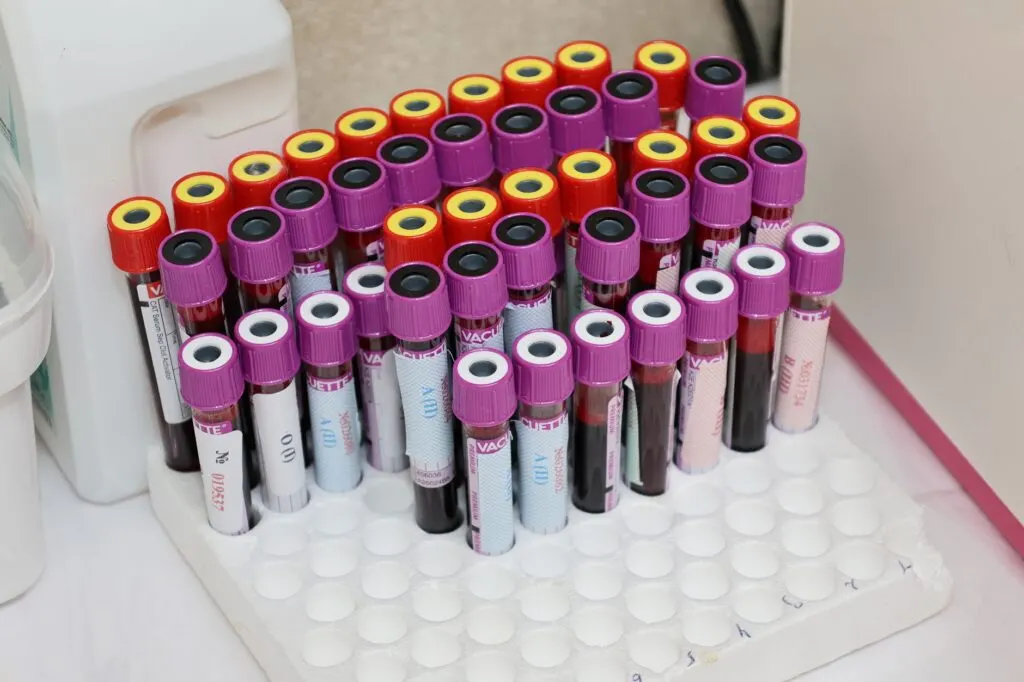
Which blood markers really reflect ageing
Some parameters of a standard blood panel, often read quickly for lack of time, in fact say a great deal about the speed at which a body is ageing. Fasting blood glucose and HbA1c inform you about glucose handling over time, a central mechanism of metabolic ageing. A blood sugar that drifts slowly upwards, even without crossing the diabetes threshold, signals insulin resistance settling in.
The lipid panel also deserves a finer reading than the simple green or red box from the laboratory. The ratio between the different cholesterol fractions, and the presence of high triglycerides combined with a large waist circumference, draw a cardiovascular risk profile far more telling than an isolated figure. The World Health Organization also reminds us that cardiovascular disease remains the leading cause of death worldwide, and that its risk factors often settle in decades before the clinical event, as detailed in the WHO fact sheet on cardiovascular diseases.
High-sensitivity CRP is another marker that is often neglected. It reflects a state of low-grade inflammation, the kind that causes neither fever nor pain but gradually wears down the vessels, the joints and sometimes the brain. A slightly raised level, held over several years, weighs on the ageing trajectory far more than a one-off peak linked to a passing infection.
Hormones count too, particularly in men after 45 and in women around the menopause. A testosterone level declining gradually, a thyroid running slow without being frankly pathological, change the energy available, the muscle mass and the mood. Those variations often stay within laboratory norms while moving away from the individual optimum of an active person.
That is precisely one of the most common traps: a result classified as normal by the laboratory does not mean it matches the optimum for a given individual. The statistical norm is built on a broad population, including sedentary and sick people. To understand that nuance better, reading your blood test differently helps you avoid missing signals that are already there.
What muscle strength and body composition reveal
Beyond blood tests, the body itself is a marker of biological age, often more telling than a laboratory figure. Grip strength, measured simply with a dynamometer, is now recognised as a robust indicator of longevity. Strength that declines faster than the average expected for your age signals a loss of muscle mass and a general weakening of the body.
Age-related muscle loss, sarcopenia, starts far earlier than most people imagine. It sets in from the forties in sedentary people, gradually and silently. An executive who has not done resistance exercise for ten years has often lost significant muscle volume without even realising it, professional life masking the loss of physical capacity behind everyday comfort.
Martine, 61, a pharmacist who owns her practice, arrived with diffuse fatigue and a grip strength of 19 kg on the right, below the 20 kg mark used as a signal of frailty in women. Her protein intake was around 0.8 g per kilo per day. After four months of strengthening at two sessions a week and a gradual move to 1.3 g per kilo, her grip had risen to 24 kg and she climbs her three flights of stairs without stopping.
Body composition, that is the split between lean mass and fat mass, is now measured precisely with tools such as bioimpedance or absorptiometry. Fat mass concentrated around the abdomen, known as visceral, weighs more heavily on metabolic ageing than fat mass distributed more peripherally. Two people with the same weight on the scales can therefore show very different risk profiles.
Working on those physical markers is not about aesthetics. Bone density, lower limb strength and overall muscle mass directly determine your future independence. That is why strength is the training you regret not having started sooner, an observation many of the people we support make after only a few months of regular practice.

How sleep and stress speed up or slow down the biological clock
Sleep acts directly on several mechanisms of biological ageing. It is during the deep sleep phases that the body repairs tissue, regulates growth hormones and clears some of the metabolic waste accumulated in the brain during the day. A sleep debt built up over several years, even a moderate one, disrupts that nightly maintenance and gradually shows up in inflammatory and metabolic markers.
The French national institute for health and medical research (Inserm) stresses that chronic sleep deprivation is associated with a higher risk of metabolic, cardiovascular and cognitive disorders, links that are now well documented in the Inserm file devoted to sleep. A business owner who regularly sleeps less than six hours a night, thinking he can compensate with willpower or caffeine, is unknowingly maintaining the ground for faster biological ageing.
Chronic stress works through a parallel mechanism. Prolonged exposure to cortisol, the stress hormone, encourages abdominal fat storage, disrupts blood sugar and sustains the low-grade inflammation mentioned above. Unlike acute, one-off stress, which is useful and adaptive, work stress installed over months or years wears down the body’s regulatory systems without ever giving them real respite.
The difference between a business owner who ages fast and one who ages slowly rarely comes down to a single spectacular factor. It often comes down to the accumulation of shortened nights, of meals eaten on the run between two meetings, and of tensions never discharged. Each of those elements seems minor on its own, but their addition over ten or twenty years produces a perfectly measurable gap in biological age.
Taking back control of those two levers does not require turning a whole professional life upside down. Targeted adjustments to bedtime, evening light and recovery time are often enough to reverse a trend that has been in place for years. It is progressive work, but its effects show up quickly in biological markers.
Where diet and advanced genetic tests fit in
Diet influences biological age through well-identified mechanisms, beyond the question of weight alone. Protein intake, often insufficient after 50, directly conditions the body’s ability to maintain its muscle mass against natural ageing. A chronic protein deficit, even a moderate one, speeds up the sarcopenia mentioned above and weakens recovery after effort or after a simple bout of fatigue.
The quality of the fats you eat also plays a role in systemic inflammation. An excess of processed fatty acids, combined with an omega-3 deficit, maintains a pro-inflammatory ground that then shows up in the blood markers mentioned earlier. Conversely, a diet rich in fibre and polyphenols supports the diversity of the gut microbiome, now recognised as a player in its own right in immune and metabolic regulation.
For a business owner whose weeks roll by without any real time to prepare meals, that balance is far from obvious. Eating well in the weeks when the days run over remains possible with a few simple principles, without needing elaborate cooking or any extra constraint in an already saturated diary.
Advanced genetic tests, particularly those measuring DNA methylation, come up regularly in discussions about biological age. They rely on epigenetic markers whose reliability research keeps refining. Those tools bring interesting additional information, but they never replace the reading of blood, physical and functional markers that are already accessible and validated by well-established clinical practice.
Caution is still warranted with certain commercial offers that promise a precise biological age to the month from a simple saliva sample. Those tools evolve fast, but a health professional remains the best person to interpret those results in the overall context of an individual, rather than taking them as an isolated truth.
How to turn those markers into a concrete action plan
Faced with that list of markers, the temptation is strong to want to measure everything and correct everything at once. That approach usually runs out of steam within a few weeks. The most effective method is to rank the levers by their impact and their ease of implementation, then move forward in measurable steps rather than by intuition.
Sleep and strength training are often the first two workstreams to open, because their effects show up quickly across several markers at once. Regular strength practice, even at two well-built sessions a week, improves insulin sensitivity, bone density and muscle mass within a few months. For an executive diary, the question is not to find unlimited time but to define how many sessions a week are really needed to produce a measurable effect.
Diet follows a similar logic of prioritisation. Before reviewing a whole way of eating, it is often more effective to secure sufficient protein at every meal, a point that many active adults largely underestimate, as the analysis devoted to protein intake after 50 shows. That single adjustment often produces visible effects on energy and recovery before you even touch the rest of the diet.
Follow-up over time remains the element that separates a serious approach from a simple good resolution. Re-measuring the same markers every few months lets you check that your efforts are producing a real effect, and adjust the strategy if a parameter is not moving as expected. Without that feedback loop, it becomes hard to know whether lifestyle changes are bearing fruit or need to be reviewed.
That is exactly the logic behind the programme offered by Elite Longevity, founded by Benjamin Sant, a Saint-Cyr officer turned longevity coach. Over a period of three to twelve months, a dedicated team and a tracking app let you re-measure biomarkers over time and adjust the levers one by one, without scattering your efforts. The starting point is a thirty-minute call, free and with no commitment, to assess where your biological age really stands and which markers would deserve priority follow-up. You can book an assessment to begin that process right now.
Sources
- An epigenetic biomarker of aging for lifespan and healthspan, Aging (Albany NY), 2018
- Epigenetic clock: A promising biomarker and practical tool in aging, Ageing Res Rev, 2022
- Epigenetic aging: Biological age prediction and informing a mechanistic theory of aging, J Intern Med, 2022
Further reading
- the thresholds for fasting blood glucose and the levers to improve it
- VO2 max, what cardio brings to longevity
- VO2 max and longevity: the inconvenient truth
- the complete guide to longevity: mechanisms, pillars and priorities
- the five anti-ageing levers that actually have data
Frequently asked questions
How is biological age measured?
There is no single test that would give an official biological age. What you measure is a set of converging markers: glucose handling through fasting blood glucose and HbA1c, the level of background inflammation, the lipid panel, plus physical measurements such as grip strength and body composition. Epigenetic clocks, which analyse DNA methylation, complete the picture in a research setting.
Are epigenetic clock tests sold online reliable?
They do measure something real, DNA methylation, but two samples from the same person can give different results, and the gaps between providers remain large. Those tools are useful for research on ageing. For a personal decision, a standard blood panel read across several years and a strength measurement remain more usable, and far less expensive.
Can you really bring your biological age down?
That wording is a shortcut. What moves are the markers: fasting blood glucose, background inflammation, muscle mass, sleep quality. Those markers respond to strength training, diet and sleep, and it is their movement in the right direction that counts, not the composite figure displayed by a test.
Which tests should I ask my doctor for to know where I stand?
A full blood panel including fasting blood glucose, HbA1c, a detailed lipid panel, a high-sensitivity CRP, vitamin D, plus liver and kidney panels, already gives a solid reading. Two free measurements usefully complete it: waist circumference and grip strength. That approach belongs to prevention and comes in addition to medical follow-up, never in place of it.
Latest from the blog
Read next
 Male menopause: myth or hormonal reality?
Male menopause does not exist medically, but testosterone does decline after 45. Here are the facts and the levers that…
Read the article
Testosterone in men: the decline after 40
Testosterone in men falls naturally with age, most often from 30 to 40 onwards, at a slow and gradual pace…
Read the article
 Healthy life expectancy: what actually moves it
You are 52, you run a company with thirty employees, and you have been stringing together twelve-hour days for almost…
Read the article