
Osteoporosis: which treatment fits your profile
Osteoporosis is treated by combining medication, prescribed by a doctor according to the measured bone density, with muscle strengthening work that acts…
By Benjamin Sant · Updated 10 November 2026
Osteoporosis is treated by combining medication, prescribed by a doctor according to the measured bone density, with muscle strengthening work that acts directly on the solidity of the bone. There is no single treatment but a gradation: calcium and vitamin D supplements for early forms, drugs that slow bone loss for established forms, and stronger injections reserved for advanced frailty or a fracture that has already occurred. The choice depends on the bone density score, age, history of fracture and each person’s tolerance of these molecules. None of these treatments works durably without parallel work on muscle mass, because bone responds to the mechanical constraints the muscles pass on to it.
You may have received a bone densitometry result that worries you, or a doctor may have suggested an annual injection without really detailing the alternatives. Many fifty-year-old managers discover their bone fragility by chance, during a routine panel, and end up facing dense medical vocabulary: bisphosphonates, denosumab, teriparatide, T-score. The issue is not only choosing a molecule, but understanding the stakes of the years that follow a diagnosis. A well-monitored treatment, combined with suitable physical activity and a protein-rich diet, genuinely changes the trajectory. This article details the available options, their effects, their limits, and the central place muscle strength holds in that equation.
Which drug treatments exist for osteoporosis?
Three main families of drugs exist today to slow the bone loss linked to osteoporosis. Bisphosphonates, taken orally or as an annual infusion, slow bone turnover by limiting the action of the cells that destroy bone. Denosumab, given by subcutaneous injection every six months, acts on a different mechanism and is often intended for people who do not tolerate bisphosphonates or whose frailty is more pronounced. Teriparatide, reserved for severe forms with vertebral fractures, instead stimulates bone formation rather than only slowing its destruction. These treatments never replace one another without medical advice: their efficacy and their side effects vary widely with each patient’s hormonal, renal and digestive profile.
The choice between these options always falls to the GP or the rheumatologist, after bone densitometry and sometimes a full calcium and phosphate panel. The article on the link between muscle loss and bone fragility details the markers to watch in order to anticipate that fragility even before a treatment becomes necessary. A study published in Metabolism in 2023 establishes a direct link between sarcopenia, osteoporosis and general frailty, which explains why the most recent protocols systematically combine bone monitoring with muscle monitoring, see the study Sarcopenia, osteoporosis and frailty. A drug treatment alone, with no attention paid to muscle mass, treats only part of the problem.
The duration of a drug treatment is generally counted in years, with regular reassessment of bone density every two to three years. Some patients stop bisphosphonates after four or five years for a therapeutic break, decided with the doctor according to the fracture risk level. Others continue without interruption, particularly where a fracture has already occurred. Side effects exist and should be discussed frankly: digestive problems with the oral forms, transient muscle pain with injections, rare but documented risks to the jaw or the femur with prolonged treatment. Those risks remain low compared with the risk of an untreated fracture, but they justify regular medical follow-up rather than a prescription frozen for years.
| Marker | Unit | Optimal zone | Warning zone | Source |
|---|---|---|---|---|
| Bone T-score | standard deviation | above minus 1 | below minus 2.5 | Inserm |
| Grip strength | kg | according to age and sex, stable over time | rapid decline over 12 months | ICFSR 2025 |
| Serum vitamin D | ng/mL | 30 to 50 | below 20 | Inserm |
| Frequency of muscle strengthening | sessions per week | 2 to 3 | 0 sessions | ICFSR 2021 |
When should you consider an injection for osteoporosis?
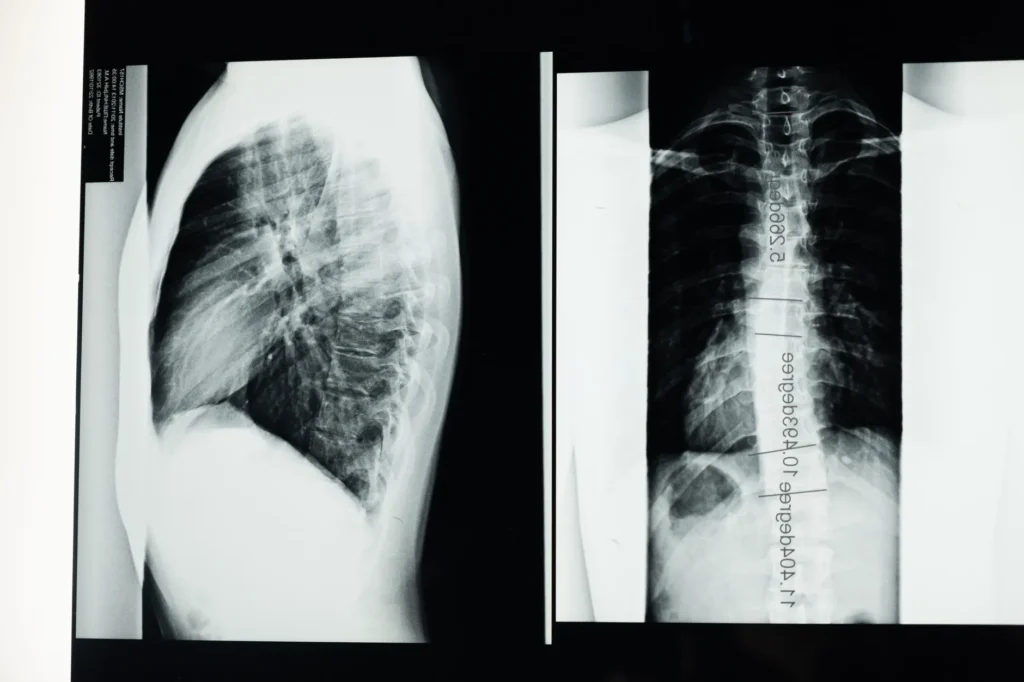
An injection for osteoporosis is considered when oral treatments are no longer enough or are not tolerated, and above all when the fracture risk is judged high by the doctor. Denosumab, injected under the skin every six months, is the most frequent option: it blocks a protein involved in bone destruction and proves particularly useful in people whose kidney function limits the use of bisphosphonates. Teriparatide, given daily by self-injection for a period limited to eighteen or twenty-four months, targets the most severe forms, often after a first vertebral fracture. These injections are never a first reflex: they belong to a strategy built with a specialist, after precise assessment of bone density and of individual risk factors.
One point deserves clarification because it comes up often in appointment: denosumab must be stopped with care, as an abrupt interruption can cause a rebound effect with accelerated bone loss. That is an important difference from bisphosphonates, which keep a residual effect after stopping. This technical point shows why no decision about these injections should be taken without structured medical follow-up, with regular bone density checks. Moving from one treatment to another, or stopping, is always planned with the prescriber, never on personal initiative, even if symptoms seem stable.
In practice, many patients wrongly equate injection with a definitive solution, thinking the drug treatment removes the need for any physical effort. That is a mistake we come across regularly in assessment: people well monitored medically, but whose muscle mass keeps declining for want of exercise. A review published in Nutrients in 2021 shows that combining regular exercise with suitable nutrition reduces the combined incidence of osteoporosis and sarcopenia, well beyond the results obtained by drug treatment alone, see the review Exercise and Nutrition Impact on Osteoporosis and Sarcopenia. The injection slows the loss, exercise builds resistance: the two do not play the same role.
Can muscle replace drug treatment?
No, muscle never replaces a drug treatment prescribed for established osteoporosis, but it largely conditions its long-term efficacy. Bone strengthens in response to the mechanical constraints the muscles pass on during effort against resistance: the more muscle strength is maintained, the more bone stimulation remains present day to day, in simple actions such as climbing stairs or carrying a load. Conversely, established muscle loss, sarcopenia, deprives bone of that stimulation and accelerates its weakening, regardless of the treatment followed. That is why a serious osteoporosis protocol always includes a muscle strengthening component, two to three sessions a week, alongside drug treatment.
Progressive resistance work, with weights or resistance bands, gives measurable results on strength without requiring complex gym equipment. An international consensus published in 2025 recommends resistance training precisely as a central pillar of exercise recommendations for extending a healthy active life beyond 50, see the ICFSR global consensus on exercise and longevity. Two structured weekly sessions, covering the large muscle groups, are already enough to slow the age-related loss of strength. The article detailing how to reverse strength loss after 50 in two sessions offers a concrete framework for starting that work without disrupting a busy diary.
Diet supports that muscle work and should not be neglected in the equation. Sufficient protein intake, spread across the day’s meals, supports muscle synthesis and limits the wasting linked to ageing. Vitamin D also plays a bridging role between the two systems, by helping calcium absorption and taking part in proper muscle function. A vitamin D deficiency, common in people who work a lot indoors or keep shifting hours, simultaneously worsens bone fragility and loss of strength. That double effect explains why a full panel, including both bone density and vitamin D status, gives a truer picture of the situation than a single isolated test.
How does a structured programme change the trajectory?
A structured programme changes the trajectory by tying together medical follow-up, muscle strengthening and nutrition in a protocol followed over several months, rather than treating each element separately. Take the case of Véronique, 64, a radiologist in a private clinic in Nancy, who has been juggling on-call shifts and consulting sessions for years. She came to see us after a colleague of the same age stopped work abruptly, having suffered a wrist fracture in an ordinary fall, saying simply that she did not want to end up in the same situation without having tried anything. Her assessment showed a bone T-score of minus 1.8 at the lumbar level and grip strength clearly below the average expected for her age. We set up two weekly sessions of progressive resistance training, protein intake spread across the three main meals, and vitamin D supplementation after a blood test. Twelve weeks later her grip strength had improved measurably and steadily, with no promise of a cure and no spectacular figure, simply a trajectory quietly turning around.
That case illustrates a more general principle: drug treatment, when prescribed, acts on bone density measured in the laboratory, while muscle work acts on day-to-day function, balance, the ability to catch yourself during a fall. These two dimensions complement each other without replacing one another. A person can have bone density stabilised by their treatment and still keep losing strength if they add no regular physical work. Conversely, intensive training does not correct a severe calcium or vitamin D deficiency, nor a hormonal imbalance that requires specific medical care.
Creatine deserves a special mention in this context, because recent work highlights its value in supporting muscle mass in older adults, alongside resistance training. A synthesis published in 2025 on creatine monohydrate supplementation in older and clinical populations confirms a favourable effect on strength when it is combined with a structured exercise programme, see the synthesis on creatine monohydrate in older adults. That kind of supplement never replaces a treatment for osteoporosis, but it fits logically into a strategy aimed at preserving both the skeleton and the musculature.
What exercise intensity is really useful after 50?
Useful intensity after 50 rests on progressive resistance training, completed with shorter more intense sequences, rather than long moderate sessions with no precise goal. A systematic review published in 2024 on high-intensity interval training shows a favourable effect on muscle strength in older people affected by sarcopenia, provided the intensity is adapted progressively to each profile, see the review on interval training and sarcopenia. It is not about reproducing an elite athlete’s training, but about introducing brief intense efforts, for example on a bike or climbing stairs, which call on the cardiovascular and muscular system more than a long walk at a steady pace.
For a manager juggling meetings and travel, the question is not finding extra time, but concentrating effort into short regular sessions. Two muscle strengthening sessions a week, combined with one or two cardiovascular sessions including phases of higher intensity, cover most of the needs identified in international recommendations. The article on the realistic number of training sessions after 45 with a full diary details how to organise that volume without sacrificing professional constraints. What matters is consistency over several months, far more than the one-off intensity of a single session.
An international consensus published in 2021 sets out the exercise benchmarks recommended for older people, insisting on the systematic combination of resistance work, balance work and moderate to intense cardiovascular activity, see the international consensus on exercise recommendations in older adults. Balance work deserves particular attention in the case of osteoporosis, because it directly reduces the risk of falling, the most frequent cause of fractures in frail people. Simple exercises, standing on one leg or walking heel to toe, practised a few minutes every day, usefully complete strength work without requiring any particular equipment.

What path should you follow after an osteoporosis diagnosis?
The path after an osteoporosis diagnosis starts with an in-depth discussion with the doctor about the bone density score obtained and the real fracture risk level, before any treatment decision. Some situations justify simple monitoring with lifestyle strengthening, others require immediate drug treatment, or even an injection depending on severity. The Inserm reference file on osteoporosis reminds us that the disease remains largely under-diagnosed, particularly in men, and that screening by bone densitometry should be offered more systematically after certain risk factors, see the Inserm Osteoporosis file. An early diagnosis opens more options and avoids waiting for a first fracture to act.
Once the diagnosis is made, building a concrete programme takes over: frequency of medical follow-up, muscle strengthening schedule, nutritional adjustment, and regular monitoring of biological markers to measure change over time. That work benefits from being led with a team familiar with the interactions between drug treatment and physical activity, rather than juxtaposing isolated advice. The article on the quantities of protein recommended after 50 provides precise benchmarks for adjusting diet alongside the muscle work undertaken.
A full assessment, including bone density, muscle strength and the relevant biological markers, gives a solid base for building that follow-up over time. At Elite Longevity, this programme runs over three to twelve months depending on goals, with a dedicated team, a tracking app and biomarkers measured again regularly to adjust the programme as time goes on. The first effects on strength are usually measured after about three weeks, without this ever replacing the GP’s opinion on the drug side. The starting point remains simple: a thirty-minute call, free and with no commitment, to review your situation and book an assessment that will give a clear snapshot of your current muscle and bone state.
Going further
- understanding the mechanisms of age-related muscle loss
- spotting the symptoms of a vitamin D deficiency
Sources
- Sarcopenia, osteoporosis and frailty, Metabolism, 2023
- Global consensus on optimal exercise recommendations for enhancing healthy longevity in older adults, J Nutr Health Aging, 2025
- Exercise and Nutrition Impact on Osteoporosis and Sarcopenia-The Incidence of Osteosarcopenia: A Narrative Review, Nutrients, 2021
- Effects of High-Intensity Interval Training on Muscle Strength for the Prevention and Treatment of Sarcopenia in Older Adults, J Clin Med, 2024
- International Exercise Recommendations in Older Adults (ICFSR): Expert Consensus Guidelines, J Nutr Health Aging, 2021
- Creatine monohydrate supplementation for older adults and clinical populations, J Int Soc Sports Nutr, 2025
- Osteoporosis file, Inserm
Frequently asked questions
What is the best treatment for osteoporosis?
There is no universal best treatment, but a treatment suited to each person’s bone density score and history. Bisphosphonates are often suitable first line, denosumab by injection for more marked cases, teriparatide for severe forms with fractures. The choice is always made with a doctor, after bone densitometry.
What is the difference between a bisphosphonate and denosumab by injection?
Bisphosphonates slow bone destruction and keep a residual effect after the treatment stops. Denosumab, injected under the skin every six months, acts on a different mechanism but requires great caution when stopping, because an abrupt interruption can cause accelerated bone loss. Medical follow-up remains essential in both cases.
Does osteoporosis treatment have serious side effects?
Side effects exist, mostly moderate: digestive problems with the oral forms, transient muscle pain with injections. Rare risks concerning the jaw or the femur have been documented for prolonged treatments, but they remain far lower than the risk of an untreated fracture. Regular medical follow-up allows them to be monitored.
How long does a treatment for osteoporosis last?
A drug treatment is generally counted in years, with bone density reassessed every two to three years. Some patients benefit from a therapeutic break after four to five years of bisphosphonates, others continue without interruption where a fracture has already occurred. The exact duration is always decided with the prescribing doctor.
Can you stop an injection for osteoporosis on your own?
No, stopping an injection such as denosumab should never be decided alone, because it can cause a rebound effect with accelerated bone loss, sometimes faster than before the treatment. Any change or interruption is planned with the GP, usually by switching to another drug to avoid that rebound.
What should you do alongside drug treatment for osteoporosis?
Resistance muscle strengthening, two to three sessions a week, stimulates bone through the mechanical constraints transmitted by the muscles. Sufficient protein intake and an adequate vitamin D status complete that work. These levers never replace medical treatment but concretely support its efficacy over time.
Latest from the blog
Read next
 VO2 max: understanding and improving your cardio
VO2 max refers to the maximum amount of oxygen your body can take up, transport and use during intense effort,…
Read the article
 Osteoporosis and sarcopenia: the muscle link
Osteoporosis is not simply isolated bone fragility: it almost always progresses alongside a loss of muscle mass and strength, a…
Read the article