
Osteoporosis and sarcopenia: the muscle link
Osteoporosis is not simply isolated bone fragility: it almost always progresses alongside a loss of muscle mass and strength, a phenomenon researchers now…
By Benjamin Sant · Updated 24 September 2026
Osteoporosis is not simply isolated bone fragility: it almost always progresses alongside a loss of muscle mass and strength, a phenomenon researchers now call osteosarcopenia. The two tissues share the same hormonal signals and the same sensitivity to inactivity, so untreated muscle decline accelerates bone weakening, and the reverse is also true. Working on strength therefore becomes a direct lever on the solidity of the skeleton, not just an aesthetic or functional goal.
Take a common situation among managers over 45: days spent sitting, journeys made by car, occasional sport limited to a Sunday walk. Strength declines without a sound, posture shifts slightly, and a routine medical check reveals bone density that is already low. That scenario, banal in appearance, hides a precise mechanism detailed in this article, with reference figures and a concrete method to act on both fronts, bone and muscle, before a fracture comes to remind you how urgent the subject is.
Why do muscle and bone decline together after 50?
Muscle and bone communicate constantly through mechanical and biochemical signals, and their simultaneous decline is not a coincidence. When muscle mass decreases, the mechanical constraint exerted on the skeleton during everyday movements decreases too, and the bone receives less stimulation to renew itself. That coupling has been formalised by several recent studies on the bone-muscle functional unit, as researchers call it, a system that ages in a coordinated way rather than as separate organs. To go further, the exercise that genuinely protects bone density after menopause is detailed by the School of Longevity.
A study published in Metabolism in 2023 describes precisely this convergence between sarcopenia, osteoporosis and frailty, highlighting that the three phenomena share common inflammatory and hormonal pathways, notably around the fall in androgens and oestrogens after menopause or andropause. That biological kinship explains why someone who loses strength also often loses bone mineral density in parallel, without any single isolated factor explaining the whole picture (Sarcopenia, osteoporosis and frailty).
A review published in Rheumatology in 2021 goes further by proposing the term osteosarcopenia to describe that overlap, and by insisting that one of the two declines often precedes the other by several years. In other words, a loss of strength detected early can announce future bone fragility, which gives a window for action before the osteoporosis diagnosis is made (Osteosarcopenia: where osteoporosis and sarcopenia collide). The body therefore sends signals before the fracture, provided you know where to look.
Which markers should you track to anticipate bone fragility?
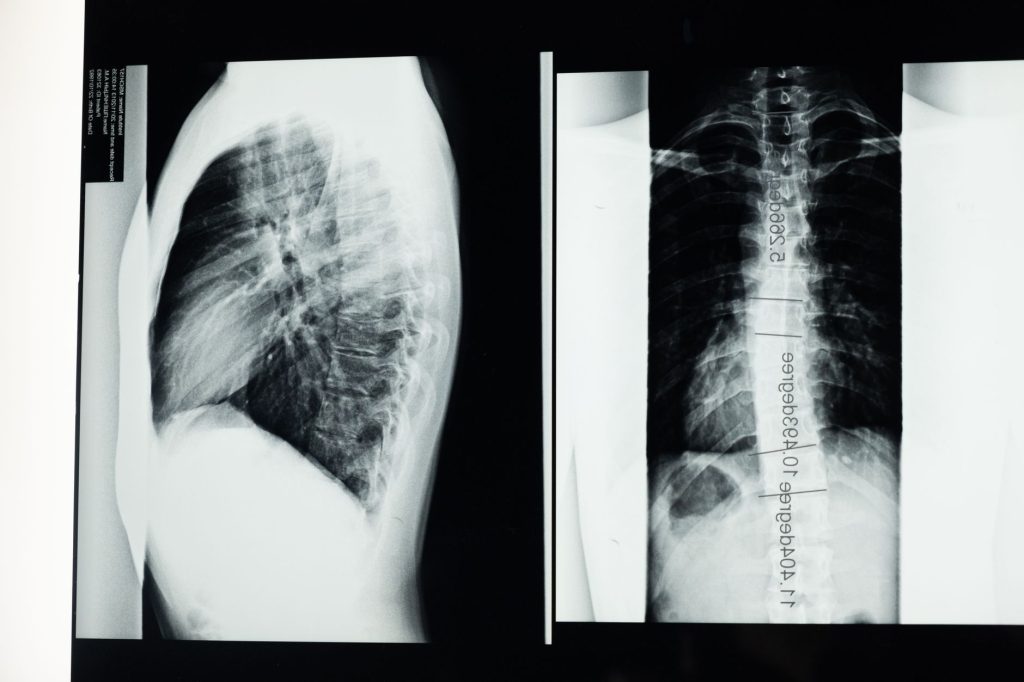
Three families of markers deserve regular attention after 45: bone mineral density, grip strength and walking speed. Bone density is measured by a DXA scan, a simple and non-invasive examination that gives a score compared with the norm for a young person. Grip strength, assessed with a dynamometer, reflects the overall muscular state of the body fairly faithfully, including in the legs and trunk. Walking speed over a short distance completes the picture by revealing function rather than structure alone.
These three measurements complement each other because they do not tell the same story. The DXA scan shows the state of the skeleton at a given moment, but says nothing about the future trajectory if the muscle around it keeps wasting away. Grip strength, for its part, often anticipates how bone will evolve over the following years, as the work on the bone-muscle functional unit shows. Combined follow-up, rather than a single isolated test, gives a fairer picture of the real fracture risk, particularly in active people who feel fit despite a silent decline.
To place these values, one reference point helps you understand where an individual result sits, knowing that a doctor remains the only person able to interpret your own assessment in context.
| Marker | Unit | Optimal zone | Alert zone | Source |
|---|---|---|---|---|
| Bone density score (T-score) | standard deviation | above minus 1 | below minus 2.5 | Inserm |
| Muscle strength lost per year after 50 | annual percentage | slowed by training | uncompensated decline | Gerontology, 2025 |
| Walking speed | metres per second | above 1 | below 0.8 | Rheumatology, 2021 |
| Recommended strength training frequency | sessions per week | two sessions | zero sessions | J Clin Med, 2024 |
Does strength training really protect the bones?
Yes, strength training acts directly on bone density, because bone responds to the mechanical constraints it undergoes during loaded exercise. Lifting a weight, pulling against resistance or doing a bodyweight exercise creates tension that travels through the tendon to the bone, and that tension triggers cellular signals that favour bone formation rather than resorption. This mechanism works at any age, including after 60 or 70, provided the load is sufficient and progressive.
A systematic review published in the Journal of Clinical Medicine in 2024 examined the effects of high-intensity interval training on muscle strength in older people, from the perspective of sarcopenia prevention. The authors note that combining strength exercises with variable intensity produces measurable strength gains within a few weeks, with benefits that go beyond simply maintaining muscle mass to reach bone function too (Effects of High-Intensity Interval Training on Muscle Strength for the Prevention and Treatment of Sarcopenia in Older Adults). Two weekly sessions are often enough to start that virtuous circle, as our article on strength after 50 details.
What matters is not raw intensity but consistency and progressive loading. An exercise that is too light does not send a sufficient signal to the bone, while a poorly controlled load exposes you to unnecessary injury risk. Support from a professional trained in adapted physical activity makes it possible to adjust that progression, particularly for someone who has never done strength training or who is returning after several years away.
How can a personalised programme reverse the trend?
A structured programme combines an initial assessment, dietary adjustment and a progressive training plan, with repeated measurements to check real rather than assumed progress. You often arrive with a vague feeling, fatigue at the end of the day, a sense of weakness in the legs when climbing stairs, without any specific symptom clearly raising the alarm. It is precisely in that vagueness that a quantified assessment makes sense, by objectifying elements that feeling alone cannot settle.
Sylvie came to see us because she felt less resilient than before, with persistent discomfort in her lower back after her days of seated work. Her assessment showed grip strength below the average expected for her age, with slightly low muscle mass measured by bioimpedance. We set up two supervised weekly strength sessions, protein intake spread over the three main meals at around twenty grams each, and vitamin D supplementation after a blood test. Twelve weeks later, her grip strength had improved measurably, and the lower back discomfort had clearly eased.
This case illustrates a simple principle: strength does not come back by chance, it responds to a precise stimulus, repeated and measured over time. Without an initial measurement, it is impossible to know whether the programme is really working or whether the improvement felt is a passing impression. That rigour in follow-up is what distinguishes a structured programme from general advice given without an individual baseline.
What role do diet and creatine play in this fight?
Diet directly supports the muscle’s capacity to rebuild after effort, and insufficient protein intake cancels out a good part of the benefits of training. After 50, protein needs rise slightly compared with younger adulthood, because the body becomes less efficient at using ingested protein for muscle building. Intake spread over the three main meals, rather than concentrated in the evening, improves muscle synthesis throughout the day, as our article on protein after 50 details.
Creatine monohydrate is one of the most studied supplements in this context. A review published in Bone in 2022 examines its specific role in sarcopenia, osteoporosis, frailty and cachexia, noting positive effects on muscle strength when combined with regular resistance training (Creatine supplementation for older adults). A more recent review published in 2025 in the Journal of the International Society of Sports Nutrition confirms that value for older and clinical populations, while reminding us that creatine acts as a complement to exercise, never in its place (Creatine monohydrate supplementation for older adults and clinical populations).
Vitamin D completes this nutritional picture, by facilitating the intestinal absorption of the calcium needed for bone mineralisation. A deficiency, frequent in people who get little sun exposure or live in a temperate climate, can slow the benefits of an otherwise well-designed training programme. A blood test makes it possible to check that status before considering supplementation, as our article on vitamin D and inflammation details.
What concrete steps should you take to protect your bones durably?
The route starts with an assessment that objectifies the real situation, rather than relying on how you feel or on the absence of obvious symptoms. A bone DXA scan, a grip strength measurement and a blood test including vitamin D form a solid base for knowing where you are starting from. Without those initial reference points, it becomes difficult to measure real progress in the following months, and the risk is to keep following an ineffective programme without knowing, or to stop a programme that was starting to pay off.
Once that assessment is done, the next step is to structure a progressive strength training programme, two sessions a week at minimum, combined with adjusted protein intake and, if necessary, vitamin D. Osteoporosis is not treated separately from muscle strength, and the reverse is also true: these two dimensions move forward together or backward together depending on the habits you put in place. Follow-up over time, with measurements repeated every three to four months, makes it possible to adjust training load and nutritional intake according to real change rather than a general assumption valid for everyone.
At Elite Longevity, that support rests on a dedicated team, a tracking app and biomarkers regularly re-measured, over a period that generally runs from three to twelve months depending on the starting situation. Benjamin Sant, a Saint-Cyr officer turned longevity coach, has built this method around rigour of measurement rather than intuition alone. The starting point remains a thirty-minute call, free and with no commitment, to place precisely where your body stands today. You can book an assessment to begin that process on concrete foundations.
Sources
- Sarcopenia, osteoporosis and frailty, Metabolism, 2023
- Osteosarcopenia: where osteoporosis and sarcopenia collide, Rheumatology (Oxford), 2021
- Effects of High-Intensity Interval Training on Muscle Strength for the Prevention and Treatment of Sarcopenia in Older Adults, J Clin Med, 2024
- Creatine supplementation for older adults: Focus on sarcopenia, osteoporosis, frailty and Cachexia, Bone, 2022
- Creatine monohydrate supplementation for older adults and clinical populations, J Int Soc Sports Nutr, 2025
- Osteoporosis file, Inserm
Open data. The sarcopenia thresholds of the European EWGSOP2 consensus and the grip strength centiles by age are published as a citable dataset under a CC BY 4.0 licence: 10.5281/zenodo.23232129.
Going further
- age-related muscle loss, and what slows it down
- two sessions a week are enough to reverse the trend
- the protein intake almost everyone is missing
- osteoporosis: which treatment fits your profile
Frequently asked questions
What is the link between osteoporosis and muscle loss?
Bones and muscles often degrade through the same hormonal and inflammatory mechanisms linked to age and inactivity. Loss of muscle mass reduces the mechanical tension that stimulates bone, which accelerates its weakening. The two phenomena feed each other, hence the term osteosarcopenia used by some researchers.
How do you know whether osteosarcopenia concerns you?
Slower walking speed, difficulty standing up from a chair without using your hands, or reduced grip strength are warning signals. Combined with a fracture after a moderate impact or a loss of height, these signs justify an assessment combining bone densitometry and measurement of muscle mass.
Should you avoid sport when you have osteoporosis?
No, inactivity worsens bone and muscle loss. Adapted movement, in particular strength training with progressive loads, stimulates bone formation instead. Fear of fracture should not lead to stopping movement, but to appropriate supervision, especially after a fracture has already occurred.
How long does it take to strengthen bones and muscles?
The first strength gains often appear between six and twelve weeks of regular training, before any measurable change in bone density. Effects on bone generally take several months, since bone remodelling is a slow process that requires repeated and lasting mechanical stimulation.
Is creatine useful if you have osteoporosis?
Creatine monohydrate is being studied for its effect on muscle strength in older people, as a complement to resistance training. It replaces neither movement nor medical follow-up. Its relevance and dosage should be discussed with a doctor, especially if you are on any treatment.
Which professional should you see for a full assessment?
A GP or a rheumatologist can prescribe a bone densitometry and point you towards a muscle assessment if needed. In parallel, support in adapted physical activity helps set up progressive and safe strength training, adjusted according to the results measured over time.
Latest from the blog
Read next
 Osteoporosis: which treatment fits your profile
Osteoporosis is treated by combining medication, prescribed by a doctor according to the measured bone density, with muscle strengthening work…
Read the article
Sarcopenia: understanding age-related muscle loss
Sarcopenia refers to the gradual loss of muscle mass and strength that settles in with age, silently, long before any…
Read the article
 VO2 max: understanding and improving your cardio
VO2 max refers to the maximum amount of oxygen your body can take up, transport and use during intense effort,…
Read the article